
The preparation notebook / 01
How to create an NCERT worksheet with answers
Your chapter. Your class. A practice sheet you can actually use tomorrow.
Choose your textbook pages, set the question mix, and review the answers. Here’s how to do it in Teachers Lab—with a free Class 10 Science worksheet to try first.
PDF · No sign-in needed · Separate answer key below
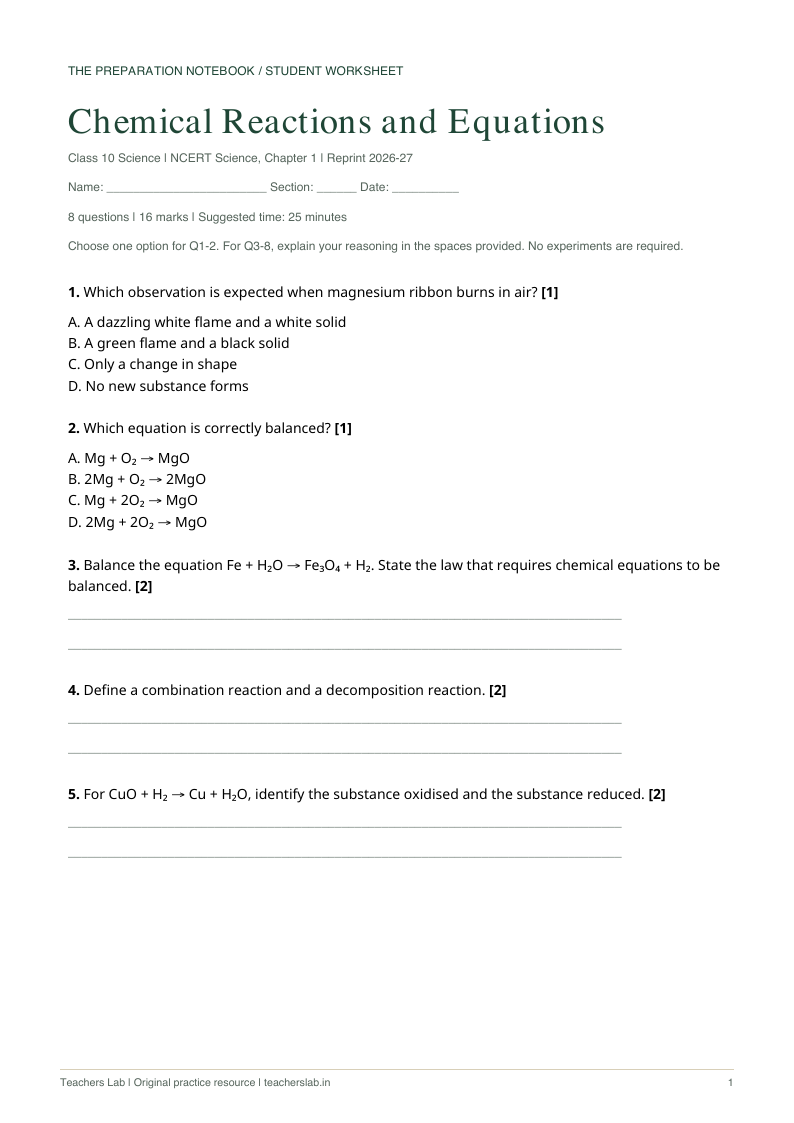
8 questions · 16 marks · Suggested time: 25 minutes
01 / The how-to
From chapter pages to a practice sheet
An NCERT worksheet should test the concepts your class has studied. Starting with selected book pages gives the AI a source to work from; you still decide whether each question belongs in your classroom.
Actual Teachers Lab workflow · Class 10 NCERT Science · Captured in Safari. Tap any screenshot to enlarge.
1. Choose the right book and edition
Sign in, set up your classroom and add its NCERT book to your shelf. Open Worksheet from the dashboard and select From my books. For this example, use Class 10 Science, Science, Chapter 1: “Chemical Reactions and Equations”. Check the title against your school’s textbook; chapter numbers can differ across editions.
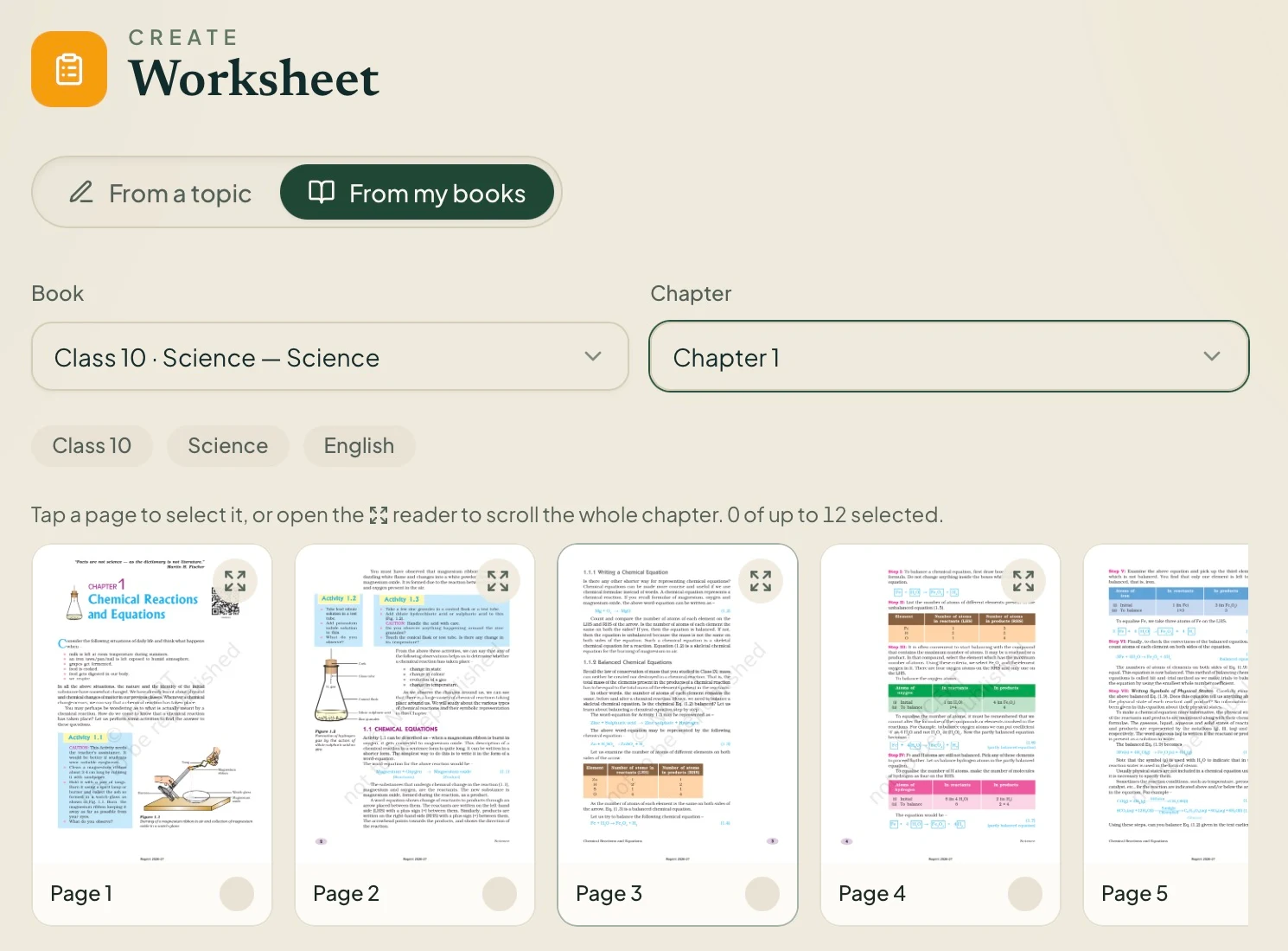
2. Select pages for what you have taught
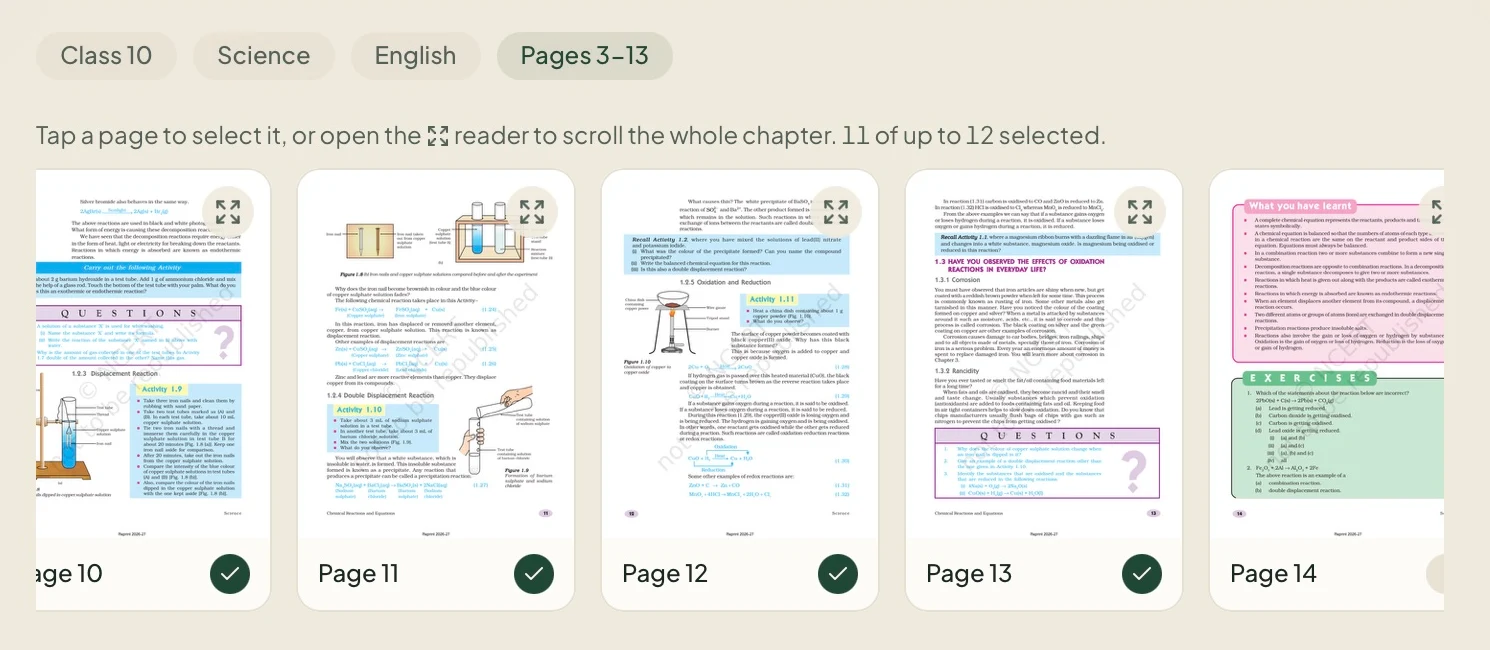
Pick the chapter and use its page previews to select relevant pages. For a short revision sheet, focus on concepts already covered in class. For this chapter, include the explanations of balancing, reaction types, oxidation and rancidity if you want to assess all four. If your class has only studied balancing, select that portion and make a focused sheet instead. The app shows your account’s page-selection limit.
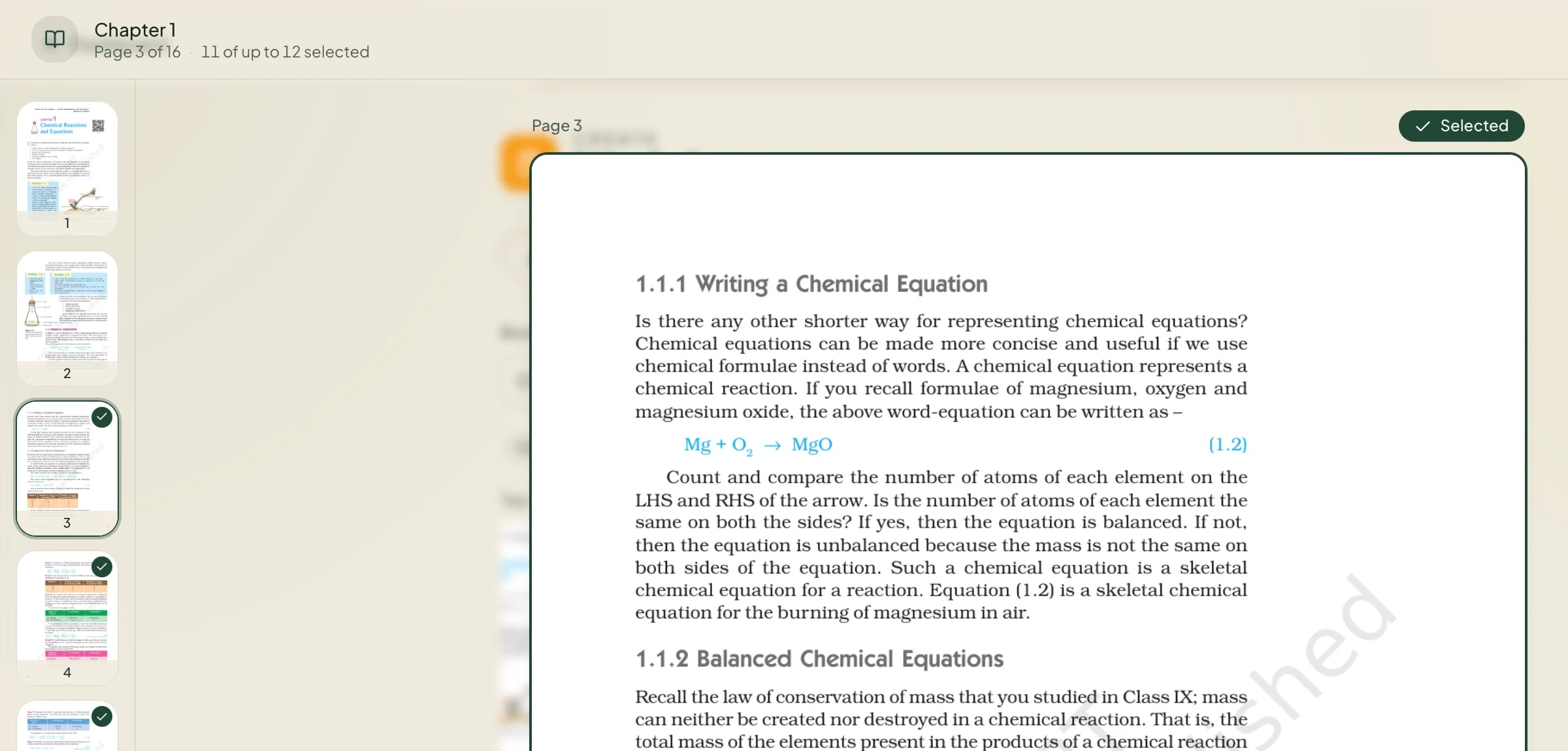
In this walkthrough, we selected chapter pages 3–13: equation writing and balancing, reaction types, oxidation, corrosion and rancidity. These are the page numbers shown in the chapter reader. For a balancing-only lesson, start with pages 3–5.
3. Set the question mix and include answers
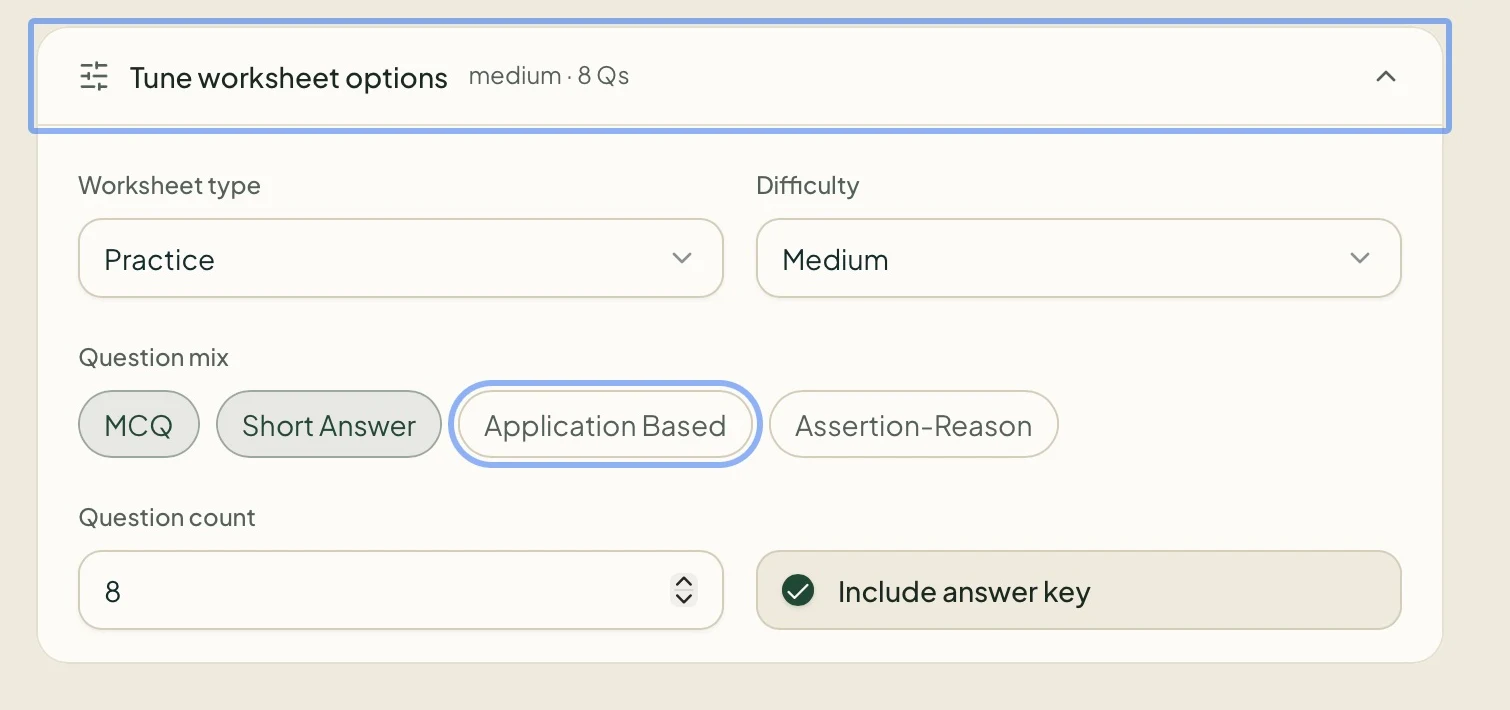
Expand Tune worksheet options. A useful starting point is Practice, medium difficulty, eight questions, and a mix of MCQ and Short Answer. Add Application Based when you want more reasoning tasks. Switch on Include answer key. These settings are a starting point; change them to match your students.
4. Generate and make it classroom-specific
Select Generate, then review the draft in the workspace. Ask for simpler wording, everyday examples, or a few questions where children explain their choices. This run produced two MCQs, three short answers and three application questions. Use Simplify or Examples in Quick refiners, or type a specific instruction in Custom request and select Create AI version.
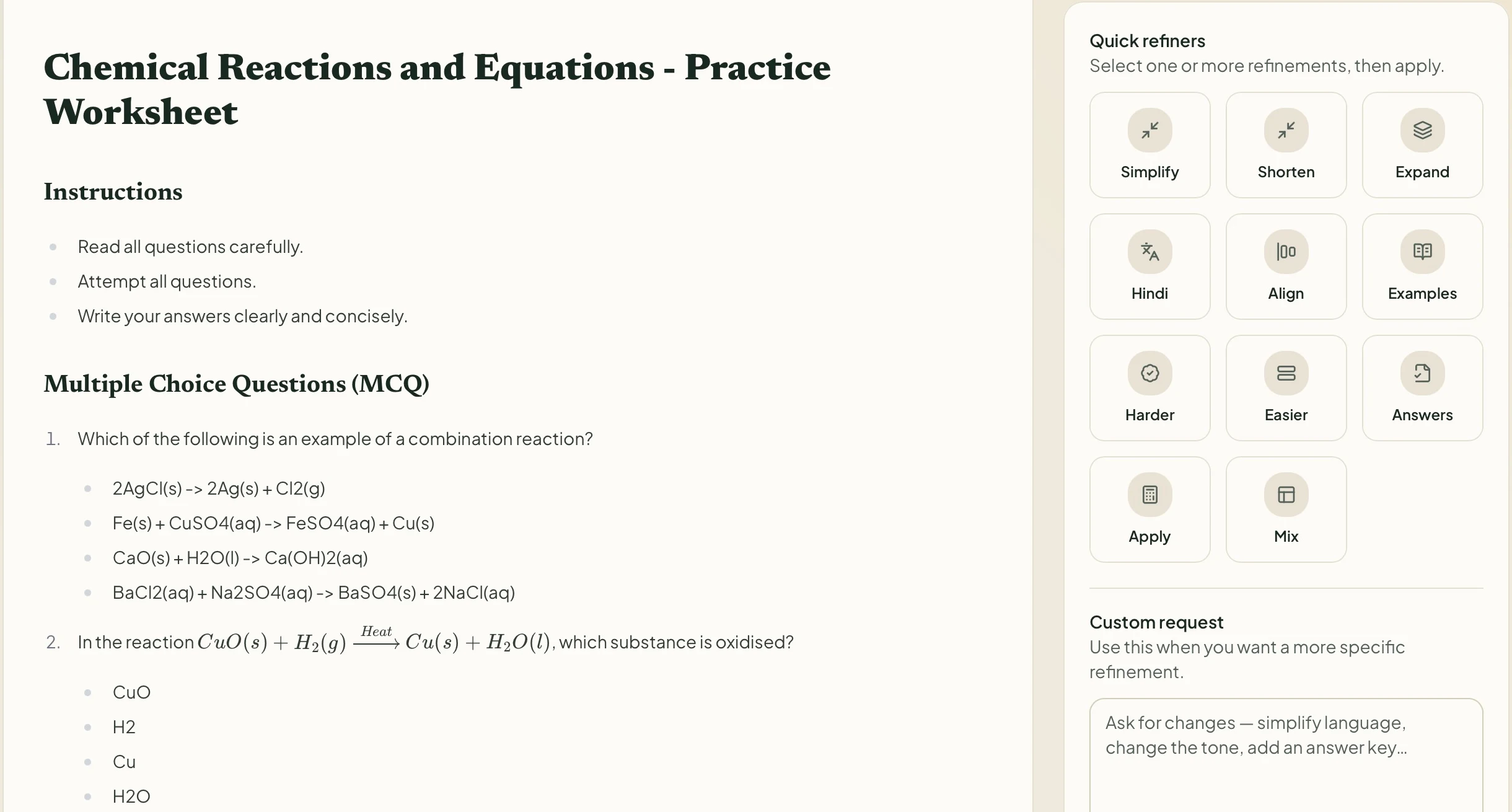
You can copy this instruction into Custom request:
Revise this Class 10 Science worksheet on Chemical Reactions and Equations to include three application questions: spotting an incorrect change to a chemical formula while balancing, explaining an iron nail in copper sulphate solution, and connecting nitrogen-filled food packets to rancidity. Ask students to explain their reasoning. Keep all questions within the selected NCERT pages. Use simple Class 10 English, leave space for answers, and put a numbered answer key after the student questions.
5. Review, then export the PDF
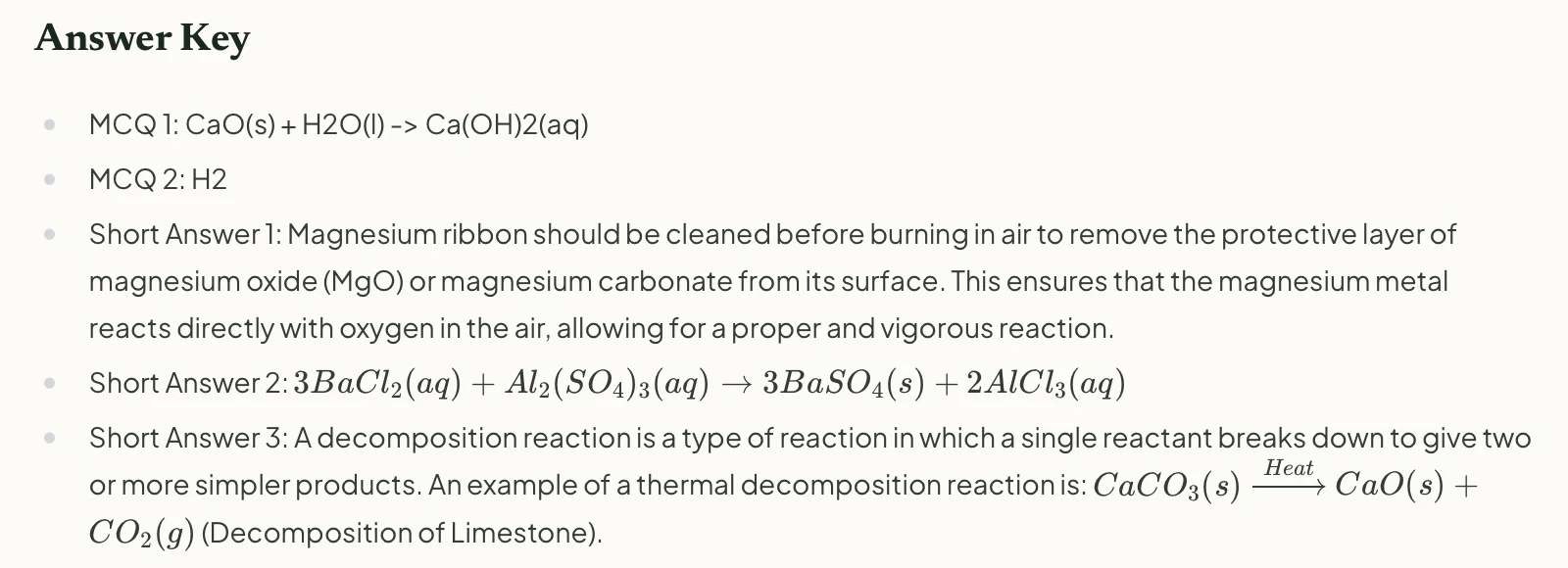
Check the questions and answers against the selected textbook pages. Use Export PDF and inspect the file before printing. If the generated PDF includes answers, prepare a separate student version without them. The sample downloads here already separate the worksheet and answer key.

02 / Ask for reasoning
Move beyond “name the reaction”
A familiar situation can reveal whether a student understands why a reaction occurs. Keep the task within the chapter and ask for an explanation, rather than making the wording harder.
What is a balanced chemical equation?
A student changes MgO to MgO₂ to balance an equation. Why is this incorrect, and how should the equation be balanced?
The second question checks whether students understand that balancing changes coefficients, not chemical formulae. Our sample includes three such application questions, with suggested marking points in the answer key.
For further examples, see CBSE’s competency-based teacher resources. The sample here is an original practice resource, not an official board assessment.
03 / Ready to try
A Class 10 Science worksheet—with answers
Based on the concepts in NCERT’s Science, Chapter 1, reprint 2026–27. The questions below are original examples. Use the student PDF for class and keep the answer key for discussion or marking.
Which observation is expected when magnesium ribbon burns in air?
Show answer 1
A dazzling white flame and a white solid. The solid is magnesium oxide.
Which equation is correctly balanced?
Show answer 2
2Mg + O₂ → 2MgO. There are two magnesium atoms and two oxygen atoms on each side.
Balance the equation Fe + H₂O → Fe₃O₄ + H₂. State the law that requires chemical equations to be balanced.
Show answer 3
3Fe + 4H₂O → Fe₃O₄ + 4H₂ (1 mark). The law of conservation of mass (1 mark).
Define a combination reaction and a decomposition reaction.
Show answer 4
In a combination reaction, two or more reactants form a single product (1 mark). In a decomposition reaction, a single reactant breaks down into two or more products (1 mark).
For CuO + H₂ → Cu + H₂O, identify the substance oxidised and the substance reduced.
Show answer 5
Hydrogen is oxidised because it gains oxygen (1 mark). Copper(II) oxide is reduced because it loses oxygen (1 mark).
A student tries to balance Mg + O₂ → MgO by changing MgO to MgO₂. Explain why this is incorrect and write the balanced equation.
Show answer 6
Changing the formula changes the identity of the substance; use coefficients instead (1 mark). The balanced equation is 2Mg + O₂ → 2MgO (1 mark).
An iron nail is placed in copper sulphate solution. State the expected colour change of the solution, describe the coating on the nail, and identify the reaction type.
Show answer 7
The blue solution becomes greenish as iron sulphate forms (1 mark). A reddish-brown copper coating forms on the nail (1 mark). This is a displacement reaction (1 mark).
A manufacturer flushes packets of oily snacks with nitrogen before sealing them. Identify the chemical process this helps prevent, explain the role of nitrogen, and suggest one other way to slow this process.
Show answer 8
It helps prevent rancidity caused by oxidation of fats and oils (1 mark). Nitrogen reduces contact with oxygen inside the packet (1 mark). Accept refrigeration, an airtight container, or suitable antioxidants as another method (1 mark).
Original Teachers Lab sample. Not published or endorsed by NCERT or CBSE. This sample was prepared for the guide; generated outputs will vary.
04 / The teacher’s check
Five checks before you print
- Chapter fit. Every question stays within the concepts and edition you teach.
- Correct answers. Check each explanation, not just the MCQ letters.
- Readable language. Students can understand the task without unnecessary vocabulary.
- Practical length. Leave enough time and writing space for explanations.
- Student copy. Answers are separate and the exported pages print clearly.
Balancing an equation does not mean changing the formula of a substance. Ask students to count the atoms on both sides and change coefficients only. For example: 2Mg + O₂ → 2MgO.
05 / Quick answers
Common questions
Can I download the sample without signing in?
Yes. The student worksheet and separate answer key on this page are free downloads. Sign in to Teachers Lab to create a worksheet from your own chapter; generation is subject to your account’s usage limits.
How do I include answers in an NCERT worksheet?
Open “Tune worksheet options” and enable “Include answer key” before generating. Check the numbered answers against the selected chapter pages before using them.
Can I make the worksheet easier for my class?
Choose an easier difficulty before generating, or ask the workspace to simplify the language, reduce the question count and add hints. Review the changes before exporting.
Is this an official NCERT worksheet?
No. This is an original Teachers Lab sample based on concepts in Science, Class 10 Science, Chapter 1, reprint 2026–27. It is not published or endorsed by NCERT or CBSE.
Your next chapter
Make one for your own class.
Start with your book pages, shape the questions, and keep the final teaching decisions with you.
Create a worksheetSign-in required · Generation follows your account’s usage limits