
THE PREPARATION NOTEBOOK / Assessment
AI for Teachers: Create a Science Quiz With Answers and Useful Follow-Up
Try a 15-question photosynthesis quiz for middle-school Science, with answers and explanations. See how teachers can use AI to draft, check and adapt classroom assessment.
Teachers Lab material · Free sample download
Written with AI assistance for Teachers Lab. Original classroom examples are provided for teachers to review, adapt and use with their own teaching judgement.
AI for teachers is useful when it supports a teaching decision
Preparing a quiz is quick only if we ignore what happens after the answers come in. A useful Science quiz tells us which explanation to revisit, which example to change and which pupils need another representation. AI can help draft the questions and alternatives; we decide what evidence those choices should reveal.
This guide demonstrates that collaboration through a photosynthesis quiz with answers for Class 7 or a comparable middle-school stage. It contains 15 original multiple-choice questions and short explanations. Check the scope against the book and edition you teach. It does not assume that every current Class 7 textbook uses the same chapter title or sequence.
Download the quiz and separate explanations
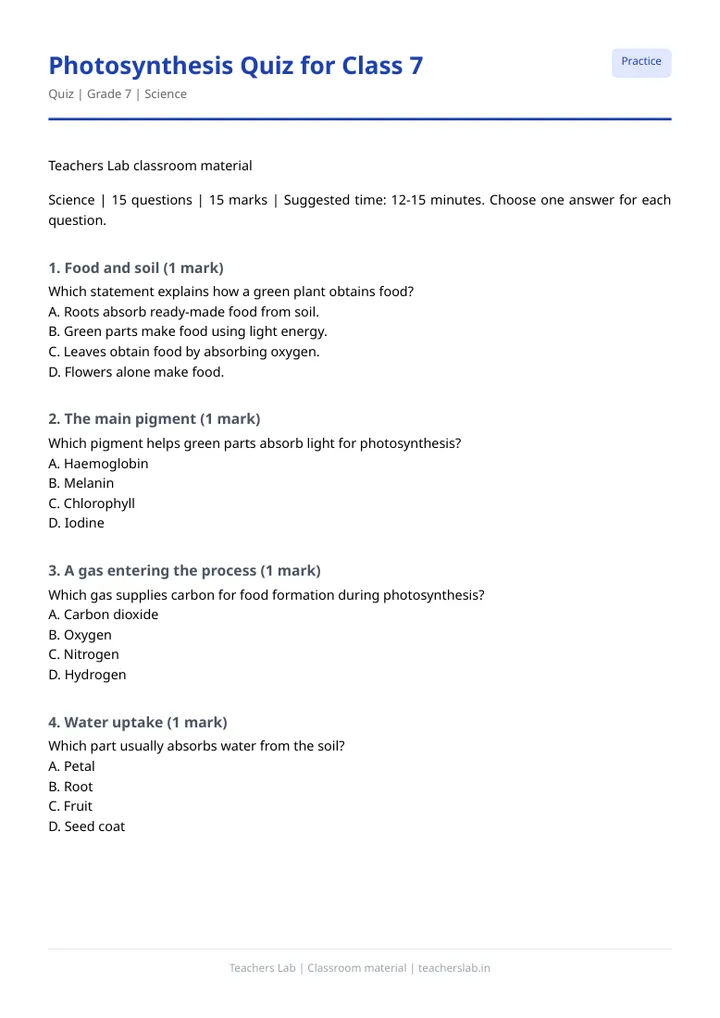
Use the student quiz and keep the teacher answer key for discussion afterwards. Allow roughly 12–15 minutes. Each question has one best answer and one mark. The questions cover inputs, products, chlorophyll, evidence and common misconceptions; they do not cover advanced biochemical pathways.
TEACHERS LAB CLASSROOM MATERIAL · 15 MARKS
QUESTION 1 · 1 MARK
Food and soil
Which statement explains how a green plant obtains food? A. Roots absorb ready-made food from soil. B. Green parts make food using light energy. C. Leaves obtain food by absorbing oxygen. D. Flowers alone make food.
Answer and explanation
- B. Green parts make food using light energy. Roots absorb water and minerals; these are not ready-made food.
QUESTION 2 · 1 MARK
The main pigment
Which pigment helps green parts absorb light for photosynthesis? A. Haemoglobin B. Melanin C. Chlorophyll D. Iodine
Answer and explanation
- C. Chlorophyll absorbs light energy. Iodine is a test reagent, not the pigment.
QUESTION 3 · 1 MARK
A gas entering the process
Which gas supplies carbon for food formation during photosynthesis? A. Carbon dioxide B. Oxygen C. Nitrogen D. Hydrogen
Answer and explanation
- A. Carbon dioxide supplies carbon. Do not confuse it with the oxygen released.
QUESTION 4 · 1 MARK
Water uptake
Which part usually absorbs water from the soil? A. Petal B. Root C. Fruit D. Seed coat
Answer and explanation
- B. Roots absorb water from soil, which the plant transports to other parts.
QUESTION 5 · 1 MARK
A product
Which gas can green plants release during photosynthesis? A. Nitrogen B. Sulfur dioxide C. Oxygen D. Helium
Answer and explanation
- C. Oxygen can leave the green parts as photosynthesis proceeds.
QUESTION 6 · 1 MARK
Energy source
Which provides energy for photosynthesis under ordinary classroom conditions? A. Sunlight B. Soil particles C. Oxygen from air D. A pot
Answer and explanation
- A. Sunlight provides energy. Soil and the pot do not supply light energy.
QUESTION 7 · 1 MARK
A leaf starch test
A prepared leaf sample turns blue-black when the teacher adds iodine solution. What does this indicate? A. Protein is present. B. Starch is present. C. The leaf contains no food. D. The leaf contains carbon dioxide bubbles.
Answer and explanation
- B. The blue-black colour indicates starch. It does not directly measure the rate of photosynthesis.
QUESTION 8 · 1 MARK
A covered leaf area
After a suitable controlled investigation, only the uncovered green part of a leaf gives a positive starch test. What does this support? A. Light is needed for starch formation in this setup. B. Soil becomes starch. C. All covered leaves lose every mineral. D. Roots make chlorophyll.
Answer and explanation
- A. The result supports the need for light in this setup, provided the other conditions were controlled.
QUESTION 9 · 1 MARK
A fair comparison
Two similar plants receive equal water and air. One receives light and the other stays in darkness. Which factor does this comparison vary? A. Pot material and water B. Light availability C. All factors together D. The kind of soil and plant
Answer and explanation
- B. Light availability is the intended variable; the other stated conditions remain comparable.
QUESTION 10 · 1 MARK
Plants at night
Which statement about respiration is correct? A. Plants respire only in sunlight. B. Plants stop respiring whenever photosynthesis stops. C. Plants respire during day and night. D. Only animals respire.
Answer and explanation
- C. Plants respire during day and night. Photosynthesis requires light, while respiration continues without it.
QUESTION 11 · 1 MARK
A green cactus stem
A cactus has green stems and leaves modified into spines. Which statement is most reasonable? A. It can never make food. B. Only its spines can make food. C. Soil supplies all its sugar. D. Its green stems can photosynthesise.
Answer and explanation
- D. Green stems can photosynthesise. Photosynthesis is not restricted to leaf blades.
QUESTION 12 · 1 MARK
Fertiliser and darkness
A green plant stays in darkness for a long time. Can adding fertiliser replace the light needed for photosynthesis? A. Yes, because fertiliser is sunlight. B. No, minerals cannot replace light energy. C. Yes, because roots turn minerals directly into light. D. No, because plants never need minerals.
Answer and explanation
- B. Minerals support growth but cannot replace the light energy used for photosynthesis.
QUESTION 13 · 1 MARK
Destarching a plant
Why might a teacher keep a suitable plant in darkness before a controlled starch investigation? A. To remove all water from it B. To make the leaves absorb iodine C. To reduce previously stored starch D. To convert soil into sugar
Answer and explanation
- C. The plant uses stored food through respiration, reducing existing starch and making the later comparison more meaningful.
QUESTION 14 · 1 MARK
A useful summary
Which word statement best summarises photosynthesis? A. Carbon dioxide + water, using light and chlorophyll, form food and oxygen. B. Oxygen + food form only soil. C. Water + minerals form light. D. Soil + oxygen form chlorophyll in every cell.
Answer and explanation
- A. The statement distinguishes the inputs, products and conditions. Light supplies energy rather than being a food molecule.
QUESTION 15 · 1 MARK
A sensible conclusion
A plant grows poorly in a dark cupboard despite receiving water. Which explanation best fits the information? A. Water prevents all growth. B. Darkness proves the soil contains no minerals. C. Lack of light limits food production by photosynthesis. D. The plant must have stopped every life process immediately.
Answer and explanation
- C. Lack of light limits photosynthesis. The observation alone does not show that all other conditions are absent or that every life process stopped.
Choose distractors that reveal a misconception
“Plants get their food from the soil” sounds plausible because roots absorb water and minerals. A quiz should distinguish those substances from the food made through photosynthesis. After pupils answer, ask them to explain the role of roots and the role of green parts. Simply announcing the correct option can leave the original model unchanged.
Another useful distinction is between photosynthesis and respiration. Green plants respire during the day and at night. In suitable light they also photosynthesise. A question that treats oxygen release in light as evidence that respiration has stopped would teach a misconception.
The quiz also avoids saying that photosynthesis occurs only in leaves. Green stems can contribute. A carefully checked qualifier such as “mainly” or “green parts” matters more than making the option sound familiar. This is one reason to read every AI-generated alternative, including the incorrect ones.
Connect evidence to the claim
A covered-leaf comparison can help pupils reason about light, but only when the conditions and observations are clear. The covered and exposed parts should otherwise be comparable. The iodine test detects starch; it is evidence used in the investigation, not a direct measurement of every stage of photosynthesis.
Discuss such experiments using a teacher-prepared demonstration or suitable observations. Do not turn a short quiz into unsupervised instructions for heating alcohol. If the practical method has not been taught, select the conceptual questions first and use the evidence items after a supervised explanation.
Ask pupils why one comparison is fairer than another. Their reasoning tells us more than an isolated correct letter. Keep the discussion at the middle-school level rather than introducing chloroplast pathways that the current lesson does not require.
Create a Science quiz from a topic or book pages
Use the quiz generator with relevant saved book pages or a topic brief. Specify the class, board, language and the ideas already taught. For an ICSE class, describe the prescribed chapter scope; for NCERT-based teaching, inspect the selected edition and pages.
Create a 10-question middle-school Science quiz on photosynthesis. Include water, carbon dioxide, sunlight, chlorophyll, products and two evidence-based questions. Use one best answer per question. Include plausible alternatives based on common misconceptions, with a separate key explaining why the correct answer fits.
Review the draft against your source. Reject alternatives that are partly correct under a reasonable interpretation. Check that a pupil can answer using the taught content. Keep the language shorter where reading demand distracts from the Science being assessed.
Turn responses into the next teaching brief
If pupils confuse minerals with food, use a labelled plant model and a short comparison. If they remember the word equation but struggle with evidence, discuss an observation and ask what it does or does not support. A high total score should not hide a cluster of errors on one idea.
Give AI a summary such as “Many pupils chose soil as the source of food; propose two short follow-up tasks.” Review the suggestions and choose one that fits your classroom. You do not need to share pupils' names or individual records for this preparation task.
For the broader workflow, read AI for Indian teachers and teaching different learning levels. The quiz is one part of preparation: the teacher supplies the context, AI helps draft, and classroom responses shape what comes next.
Common questions
Is this a Class 11 or NEET photosynthesis quiz?
No. It is middle-school practice on concepts and simple evidence. It excludes detailed biochemical pathways.
Can AI decide the next lesson automatically?
This guide shows a teacher-led workflow: review response patterns, ask AI for possible tasks, then choose and check the follow-up yourself.
Can I use fewer than 15 questions?
Yes. Select questions matching the ideas already taught. Keep the separate explanations for a short discussion after the quiz.
YOUR NEXT CLASS
Create a version for your classroom.
Bring your topic or book pages, then review and refine the resource for your students.
Start in Teachers Lab