
THE PREPARATION NOTEBOOK / Worksheets
Large Numbers Around Us Class 7 Worksheet With Answers: Free PDF
Practise Indian and international number systems, place value, estimation and reasoning with an original Class 7 worksheet, worked answers and an AI-assisted adaptation workflow.
Teachers Lab material · Free sample download
Written with AI assistance for Teachers Lab. The classroom examples are starting points for teachers to review and adapt.
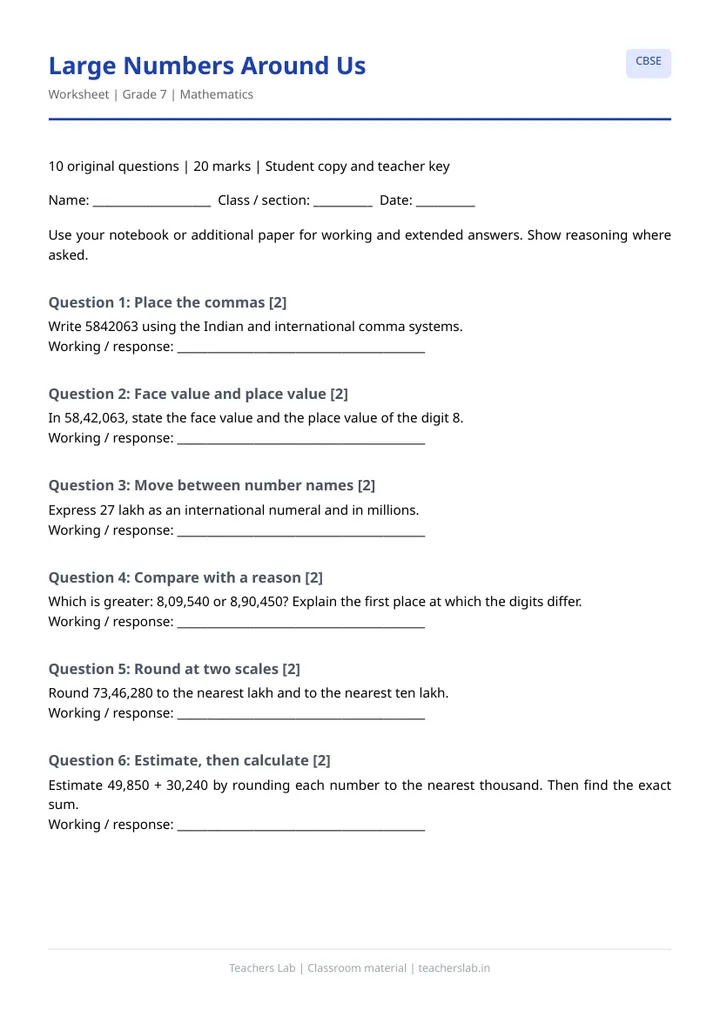
A worksheet should reveal how pupils read a number
A child can put commas in the right places and still be unsure what a digit represents. Another may calculate accurately but confuse a lakh with a million. Before we add more exercises, it helps to decide which of those gaps the worksheet should make visible.
Let’s use Large Numbers Around Us, the opening chapter in NCERT’s Class 7 Ganita Prakash contents, as our starting point. The Teachers Lab sheet below combines short calculations with explanation questions. The questions are original classroom material; the chapter provides the topic context.
You bring the knowledge of what your class has covered. AI can help draft a useful range of items. The important collaboration happens when you inspect that draft, choose the questions and decide what an answer will tell you.
Download the worksheet and separate teacher key
The free packet contains ten questions worth 20 marks, followed by worked answers. Each question has two marking points. Pupils can show their working in their notebooks or on a separate sheet; decide the amount of writing space your class needs before printing a batch.
TEACHERS LAB CLASSROOM MATERIAL · 20 MARKS
QUESTION 1 · 2 MARKS
Place the commas
Write 5842063 using the Indian and international comma systems.
Suggested answer and marking points
- Indian system: 58,42,063.
- International system: 5,842,063.
QUESTION 2 · 2 MARKS
Face value and place value
In 58,42,063, state the face value and the place value of the digit 8.
Suggested answer and marking points
- The face value is 8.
- The digit is in the lakh place, so its place value is 8,00,000.
QUESTION 3 · 2 MARKS
Move between number names
Express 27 lakh as an international numeral and in millions.
Suggested answer and marking points
- 27 lakh = 2,700,000.
- 2,700,000 = 2.7 million.
QUESTION 4 · 2 MARKS
Compare with a reason
Which is greater: 8,09,540 or 8,90,450? Explain the first place at which the digits differ.
Suggested answer and marking points
- 8,90,450 is greater.
- The lakh digits are equal; at the ten-thousands place, 9 is greater than 0.
QUESTION 5 · 2 MARKS
Round at two scales
Round 73,46,280 to the nearest lakh and to the nearest ten lakh.
Suggested answer and marking points
- Nearest lakh: 73,00,000, because the ten-thousands digit is 4.
- Nearest ten lakh: 70,00,000, because the lakhs digit is 3.
QUESTION 6 · 2 MARKS
Estimate, then calculate
Estimate 49,850 + 30,240 by rounding each number to the nearest thousand. Then find the exact sum.
Suggested answer and marking points
- 50,000 + 30,000 gives an estimated sum of 80,000.
- The exact sum is 80,090.
QUESTION 7 · 2 MARKS
Make sense of a school order
A school orders 125 boxes containing 800 sheets each. Find the total number of sheets and express it in lakhs.
Suggested answer and marking points
- 125 x 800 = 1,00,000 sheets.
- 1,00,000 sheets equals 1 lakh sheets.
QUESTION 8 · 2 MARKS
Read a change in attendance
A fictional science exhibition recorded 4,82,750 visitors last year and 5,19,360 this year. How many more visitors came? Show your calculation.
Suggested answer and marking points
- Subtract the earlier count from the later count: 5,19,360 - 4,82,750.
- The increase is 36,610 visitors.
QUESTION 9 · 2 MARKS
Use every digit once
Use the digits 0, 1, 3, 5, 7, 8 and 9 exactly once to make the greatest and the smallest seven-digit numbers. A number cannot begin with zero.
Suggested answer and marking points
- Greatest: 98,75,310.
- Smallest: 10,35,789; choose 1 first, then arrange the remaining digits in ascending order.
QUESTION 10 · 2 MARKS
Explain a misconception
A pupil says that 6,05,040 and 6,50,040 are equal because zeros do not matter. Explain the error and find the difference.
Suggested answer and marking points
- Position matters: the digit 5 represents 5,000 in 6,05,040 and 50,000 in 6,50,040.
- 6,50,040 - 6,05,040 = 45,000, so the numbers are not equal.
Work through a place-value example together
Consider 58,42,063. The digit 8 has face value 8, but its place value is 8,00,000. If a pupil writes 80,000, simply marking it wrong gives us little information. Ask them to point to the lakh and ten-thousand places, then explain which one contains the 8.
The comma task makes a different distinction: 58,42,063 and 5,842,063 represent the same quantity using different grouping systems. Changing the separators should not change the digits or the quantity. A useful board discussion is to ask pupils to explain what stays the same.
For rounding, invite a prediction before a calculation. Is 73,46,280 closer to 73 lakh or 74 lakh? The teacher can decide whether the class needs a number line, a spoken comparison or a place-value table. AI can suggest these representations, but the pupils’ explanations tell you which one to use next.
Choose a purposeful question mix
The packet moves through four needs: reading and representing numbers; understanding position; estimating and calculating; and explaining a claim. You do not have to use all ten questions in one sitting.
Try Questions 1–4 as a short diagnostic after introducing the number systems. Use the estimate-and-calculate question when you want pupils to check whether a result is sensible. Keep the final misconception task for discussion: it asks pupils to explain why moving a digit changes its value.
If you adapt the sheet, keep at least one question whose answer includes a reason. Ten similar calculations can conceal a misconception that one well-chosen explanation would uncover.
Build a version with Teachers Lab
Open Worksheet. Choose From my books, select the relevant Class 7 Mathematics book and chapter, and check the selected pages in the reader. Book editions can differ, so choose the source you actually teach from. If that book or edition is unavailable, use From a topic and state the intended scope.
Set the class, subject, board and teaching language. In the available worksheet options, choose a suitable question mix and include an answer key. Give the app a teaching purpose as well as a topic:
Prepare a Class 7 worksheet on large numbers using the selected pages. Include Indian and international grouping, place value, rounding and estimation. Add two questions that ask pupils to explain a misconception. Give separate worked answers. Keep the language direct and use original numerical examples.
Now review as a teacher. Check every comma, zero, conversion and calculation. Ask whether the explanation questions are answerable from the material taught. If an item is too demanding, use Simplify or a custom instruction to adjust that item while keeping the mathematical idea.
Let the answers shape the next lesson
A wrong calculation and a wrong interpretation need different follow-up. If most pupils read the quantity correctly but make arithmetic slips, a short checking routine may help. If they confuse lakh and million, return to representations before increasing the numbers.
Ask AI for a small follow-up set based on the pattern you observed, without adding pupils’ names or personal details. For example: “Give three comparisons that distinguish lakh from million, with a place-value scaffold for the first.” You select the final questions and review their answers.
Save the version you use with the classroom’s other resources. Add your own note about what needs revisiting to your next preparation brief. That makes the worksheet part of a continuing teaching decision rather than an isolated download.
Common questions
Is the answer key included?
Yes. The PDF includes a student copy followed by worked answers and two classroom marking points per question.
Must I use the whole worksheet at once?
No. Select the questions that match the content taught and use pupils’ explanations to decide the follow-up.
Can I make a Hindi version?
Teachers Lab supports Hindi resource preparation. Review the mathematical vocabulary, number names and worked answers before using an adapted version.
YOUR NEXT CLASS
Create a version for your classroom.
Bring your topic or book pages, then review and refine the resource for your students.
Start in Teachers Lab