
THE PREPARATION NOTEBOOK / Worksheets
Perimeter and Area Class 6 Worksheet With Answers: Printable PDF
Use ten original Class 6 perimeter and area questions with worked answers. Explore units, missing sides and real classroom contexts, then adapt the sheet with Teachers Lab.
Teachers Lab material · Free sample download
Written with AI assistance for Teachers Lab. The classroom examples are starting points for teachers to review and adapt.
Start with the difference between a border and a surface
“Which formula should I use?” can hide an earlier question: “What am I trying to measure?” A pupil who multiplies two side lengths when asked for fencing may need a clearer picture of the boundary before another formula drill.
Let’s build practice around that distinction. NCERT’s Class 6 Perimeter and Area chapter provides the topic scope. Our original worksheet adds school and garden situations, explanations and a few tasks that ask pupils to work backwards.
AI can draft different examples quickly. Your role is to choose the representations and difficulty that fit the class, then check that the question and answer agree. The result should feel like material prepared for your pupils.
Download ten questions and the teacher key
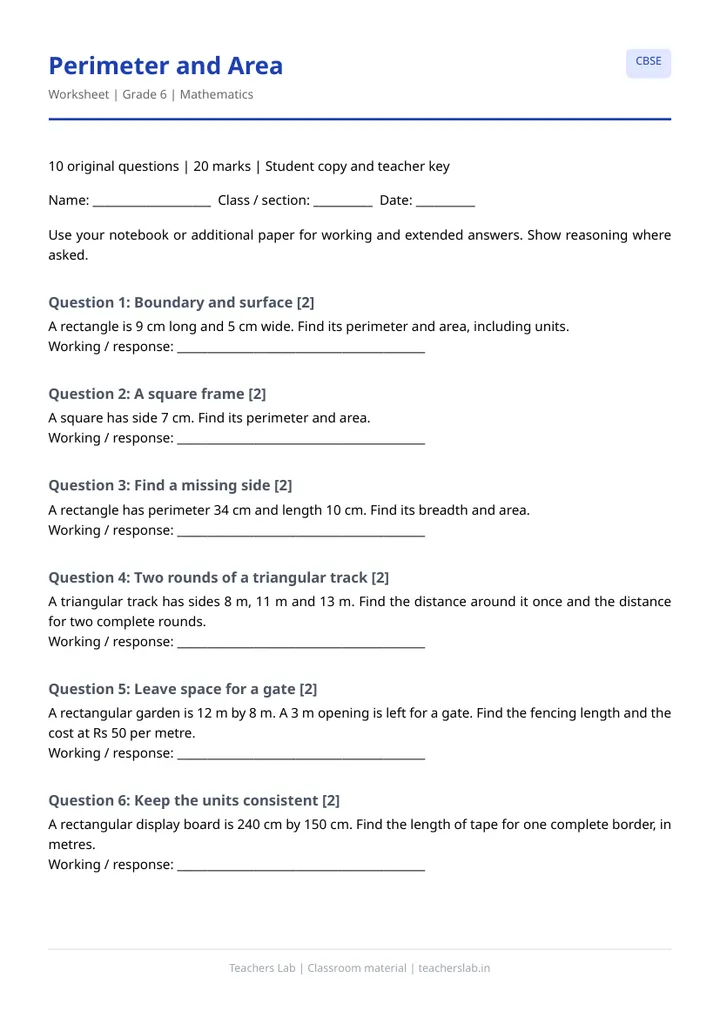
The packet contains a 20-mark student sheet followed by worked answers. Each question has two classroom marking points. Give pupils additional working space where required, particularly for diagrams and the multi-step questions.
TEACHERS LAB CLASSROOM MATERIAL · 20 MARKS
QUESTION 1 · 2 MARKS
Boundary and surface
A rectangle is 9 cm long and 5 cm wide. Find its perimeter and area, including units.
Suggested answer and marking points
- Perimeter = 2 x (9 + 5) = 28 cm.
- Area = 9 x 5 = 45 square cm.
QUESTION 2 · 2 MARKS
A square frame
A square has side 7 cm. Find its perimeter and area.
Suggested answer and marking points
- Perimeter = 4 x 7 = 28 cm.
- Area = 7 x 7 = 49 square cm.
QUESTION 3 · 2 MARKS
Find a missing side
A rectangle has perimeter 34 cm and length 10 cm. Find its breadth and area.
Suggested answer and marking points
- Length + breadth = 34 / 2 = 17 cm, so breadth = 17 - 10 = 7 cm.
- Area = 10 x 7 = 70 square cm.
QUESTION 4 · 2 MARKS
Two rounds of a triangular track
A triangular track has sides 8 m, 11 m and 13 m. Find the distance around it once and the distance for two complete rounds.
Suggested answer and marking points
- One round = 8 + 11 + 13 = 32 m.
- Two rounds = 2 x 32 = 64 m.
QUESTION 5 · 2 MARKS
Leave space for a gate
A rectangular garden is 12 m by 8 m. A 3 m opening is left for a gate. Find the fencing length and the cost at Rs 50 per metre.
Suggested answer and marking points
- Boundary = 2 x (12 + 8) = 40 m; fencing needed = 40 - 3 = 37 m.
- Cost = 37 x 50 = Rs 1,850.
QUESTION 6 · 2 MARKS
Keep the units consistent
A rectangular display board is 240 cm by 150 cm. Find the length of tape for one complete border, in metres.
Suggested answer and marking points
- Perimeter = 2 x (240 + 150) = 780 cm.
- 780 cm = 7.8 m of tape.
QUESTION 7 · 2 MARKS
Same perimeter, different area
Compare rectangles measuring 8 cm by 3 cm and 6 cm by 5 cm. Do they have equal perimeters? Do they have equal areas?
Suggested answer and marking points
- Both perimeters are 22 cm: 2 x (8 + 3) = 2 x (6 + 5).
- Their areas differ: 24 square cm and 30 square cm.
QUESTION 8 · 2 MARKS
Work backwards from area
A square has area 81 square cm. Find its side length and perimeter.
Suggested answer and marking points
- The side is 9 cm because 9 x 9 = 81.
- Perimeter = 4 x 9 = 36 cm.
QUESTION 9 · 2 MARKS
Cover a classroom floor
A 6 m by 4 m floor is covered with square tiles of side 50 cm, with no gaps or wastage. How many tiles are needed? Show your method.
Suggested answer and marking points
- Floor area = 24 square m; each tile has side 0.5 m and area 0.25 square m.
- Number of tiles = 24 / 0.25 = 96.
QUESTION 10 · 2 MARKS
A shape with a corner removed
A rectangle is 8 cm by 6 cm. A 3 cm by 2 cm rectangle is removed from its top-right corner. Find the remaining area and explain why subtracting the two perimeters would not give the new perimeter.
Suggested answer and marking points
- Remaining area = (8 x 6) - (3 x 2) = 48 - 6 = 42 square cm.
- Removing the corner exposes two new boundary segments, so perimeters cannot simply be subtracted. The new perimeter is 28 cm, but only the explanation is required.
Make units part of the reasoning
For a rectangle measuring 9 cm by 5 cm, the perimeter is 28 cm and the area is 45 square cm. Ask a pupil to trace the boundary, then indicate the surface being covered. The units express the difference: length for the boundary, square units for the surface.
Question 6 uses a display board measured in centimetres but asks for tape in metres. A correct calculation of 780 is incomplete until the unit is clear. We can ask AI to suggest another conversion example, but we still need to inspect the numbers, conversion and final wording ourselves.
When discussing square units, use a small grid drawing if it helps. A child should be able to explain why multiplying length by breadth counts rows of equal squares, rather than treating the formula as a label attached to any rectangle.
Use the questions to uncover three misconceptions
Same perimeter does not guarantee the same area. The 8 cm by 3 cm and 6 cm by 5 cm rectangles both have perimeter 22 cm, but their areas are 24 and 30 square cm. Let pupils test the claim using drawings before accepting the calculation.
An opening changes the amount of fencing. A garden’s full boundary is not always the length of fence to buy. The gate question asks pupils to interpret the situation before applying the cost per metre.
Area can be subtracted when a piece is removed; perimeter needs a new boundary check. The corner-removal question is a useful extension after drawing the shape. If it is beyond the current lesson, leave it for a later discussion. You can use the first nine questions without rushing to include the extension.
Adapt the sheet through a teacher–AI conversation
In Teachers Lab, open Worksheet and choose the relevant saved book pages or From a topic. Set Class 6, Mathematics, the board and teaching language, then choose the available question and answer-key options.
A useful first brief is:
Create a Class 6 worksheet on perimeter and area of rectangles and squares. Include boundary-versus-surface interpretation, units, one missing-side question and one same-perimeter comparison. Use original examples with sensible dimensions. Provide worked answers and explicit marking points.
After reading the draft, refine a specific problem. “Make it easier” is a start, but a more helpful instruction names what should change: “Keep the same reasoning, replace decimal measurements with whole numbers, and provide a labelled rectangle for the first item.” Check the adapted question and its answer again.
If a drawing is necessary to answer a question, make sure it is actually present and legible in the final resource. A prompt that merely says “see the figure” is not enough. Our questions state the measurements in words so the numerical information remains available.
Keep the next step small
You do not need a second full worksheet immediately. After marking, choose one pattern to address. Perhaps pupils know both formulas but confuse centimetres and square centimetres. A two-question oral comparison may be more useful than another page of calculations.
Ask AI for a few contrasting situations, inspect them, and choose the most useful pair. Keep the explanation task accessible to everyone, while offering a separate extension to pupils ready for it.
Before class, check calculations, units, answer space and the exported PDF. Save the version you teach from so later adaptations begin with a known resource and your classroom observations.
Common questions
Does the PDF include worked answers?
Yes. Each of the ten questions has a worked response and two classroom marking points.
Is the corner-removal task essential?
No. It is an extension. Draw and discuss the shape when pupils are ready to compare how area and boundary change.
Can the same sheet support different learning levels?
Yes. Select a common core, add a scaffold where needed and offer a separate extension while keeping the learning outcome clear.
YOUR NEXT CLASS
Create a version for your classroom.
Bring your topic or book pages, then review and refine the resource for your students.
Start in Teachers Lab