
THE PREPARATION NOTEBOOK / Worksheets
English Grammar Worksheets for Class 6: Tenses With Answers
Download a printable Class 6 English grammar worksheet with 20 tenses questions and a separate answer key. Adapt the practice for CBSE or ICSE classroom needs.
Teachers Lab material · Free sample download
Written with AI assistance for Teachers Lab. Original classroom examples are provided for teachers to review, adapt and use with their own teaching judgement.
English grammar practice with a clear purpose
An English grammar worksheet should help us see how a child chooses a verb form in context. A pupil may recite the rules for the simple present but still write “Rupa walk to school.” Another may recognise yesterday as past time and then forget to change the verb. Those are different needs, and the next explanation should reflect that.
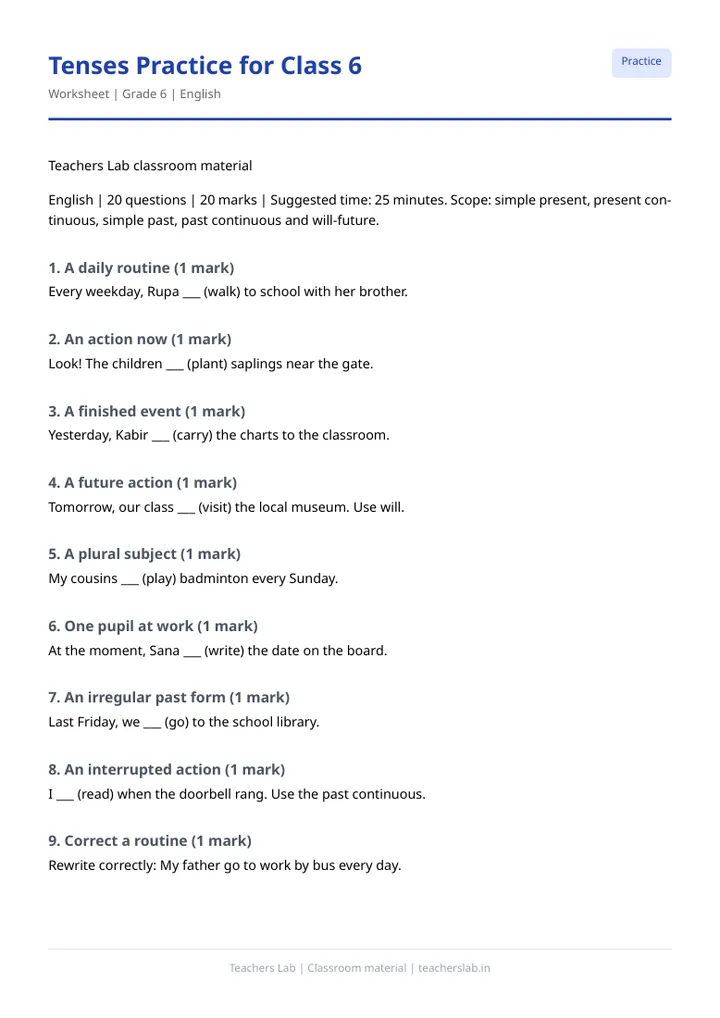
This tenses worksheet for Class 6 with answers contains 20 original questions. It covers the simple present, present continuous, simple past, past continuous and a will-future construction. The final four questions belong to a short library note, so pupils must connect the time cues across sentences.
Download the worksheet and separate answer key
Use the student worksheet for classwork and keep the teacher answer key separately. Allow about 25 minutes and award one mark per question. Pupils can write in their notebooks; the packet does not provide a large writing box for every response.
TEACHERS LAB CLASSROOM MATERIAL · 20 MARKS
QUESTION 1 · 1 MARK
A daily routine
Every weekday, Rupa ___ (walk) to school with her brother.
Answer and short explanation
- walks. Rupa is third-person singular; the routine takes the simple present.
QUESTION 2 · 1 MARK
An action now
Look! The children ___ (plant) saplings near the gate.
Answer and short explanation
- are planting. The action is happening now; children is plural.
QUESTION 3 · 1 MARK
A finished event
Yesterday, Kabir ___ (carry) the charts to the classroom.
Answer and short explanation
- carried. Yesterday places the completed action in the simple past.
QUESTION 4 · 1 MARK
A future action
Tomorrow, our class ___ (visit) the local museum. Use will.
Answer and short explanation
- will visit. Will is followed by the base form visit.
QUESTION 5 · 1 MARK
A plural subject
My cousins ___ (play) badminton every Sunday.
Answer and short explanation
- play. A plural subject uses the base form in the simple present.
QUESTION 6 · 1 MARK
One pupil at work
At the moment, Sana ___ (write) the date on the board.
Answer and short explanation
- is writing. A singular subject takes is with the -ing form.
QUESTION 7 · 1 MARK
An irregular past form
Last Friday, we ___ (go) to the school library.
Answer and short explanation
- went. Went is the simple past of go.
QUESTION 8 · 1 MARK
An interrupted action
I ___ (read) when the doorbell rang. Use the past continuous.
Answer and short explanation
- was reading. The longer action was in progress when the shorter event occurred.
QUESTION 9 · 1 MARK
Correct a routine
Rewrite correctly: My father go to work by bus every day.
Answer and short explanation
- My father goes to work by bus every day. The singular subject needs goes.
QUESTION 10 · 1 MARK
Correct an action now
Rewrite correctly: The girls is rehearsing for the assembly now.
Answer and short explanation
- The girls are rehearsing for the assembly now. Girls requires are.
QUESTION 11 · 1 MARK
Correct a completed event
Rewrite correctly: Yesterday, Leena buy a notebook.
Answer and short explanation
- Yesterday, Leena bought a notebook. Buy changes to bought in the simple past.
QUESTION 12 · 1 MARK
Correct a future form
Rewrite correctly: I will brought my ruler tomorrow.
Answer and short explanation
- I will bring my ruler tomorrow. Use the base form after will.
QUESTION 13 · 1 MARK
A present question
Make a question beginning with Does: Arjun reads the newspaper every morning.
Answer and short explanation
- Does Arjun read the newspaper every morning? Use read after does.
QUESTION 14 · 1 MARK
A present negative
Make negative using does not: The school bus stops near the bridge.
Answer and short explanation
- The school bus does not stop near the bridge. Use stop after does not.
QUESTION 15 · 1 MARK
A past question
Make a question beginning with Did: They finished the poster yesterday.
Answer and short explanation
- Did they finish the poster yesterday? Use finish after did.
QUESTION 16 · 1 MARK
A past negative
Make negative using did not: Meera took the blue folder.
Answer and short explanation
- Meera did not take the blue folder. Use take after did not.
QUESTION 17 · 1 MARK
A library routine
Complete the library note: Every Tuesday, our group ___ (meet) in the reading room.
Answer and short explanation
- meets. Group is the singular subject in this sentence.
QUESTION 18 · 1 MARK
Yesterday in the library
Continue the note: Yesterday, we ___ (choose) a story about a river.
Answer and short explanation
- chose. Yesterday calls for the simple past of choose.
QUESTION 19 · 1 MARK
The library now
Continue the note: Right now, I ___ (read) its opening page.
Answer and short explanation
- am reading. I takes am in the present continuous.
QUESTION 20 · 1 MARK
The next meeting
Finish the note: Next Tuesday, we ___ (discuss) the ending. Use will.
Answer and short explanation
- will discuss. The action is planned for the future; will takes discuss.
Teach the choice before the rule label
Read “Every weekday, Rupa ___ to school” aloud. First ask whether the sentence describes a routine, an action happening now or a completed event. Then connect routine to the simple present and Rupa to the singular verb walks. That short conversation distinguishes time meaning from subject–verb agreement.
For “Look! The children ___ saplings,” pupils need are planting. Ask them why “is planting” is unsuitable even though the action is happening now. When a pupil gets the tense right but chooses the wrong auxiliary, the correction should name the plural subject rather than simply repeat the whole tense table.
Questions using did offer another useful check. In “Did Kabir carry the charts?” the past is expressed by did; carry stays in its base form. Accepting “Did Kabir carried” would hide an important misconception. The answer key includes short reasons so marking can lead into feedback.
Adapt English worksheets for CBSE and ICSE
Grammar practice can be relevant to both CBSE and ICSE classrooms, but the class label alone does not establish the school's sequence or prescribed text. Check which forms your pupils have actually studied. This is original skill practice, not an official board worksheet or a named NCERT grammar chapter.
For a class still consolidating simple forms, select the matching questions and teach continuous forms later. For pupils ready for more, ask them to explain why two plausible forms would change a sentence's meaning. Keep the original question unambiguous if you are using a single-answer marking key.
You can also link grammar to a reading passage from your current book. Ask pupils to identify a time cue, explain its effect, then write a new sentence about the same event. A short application is often a better extension than adding an unrelated advanced tense.
Create another worksheet with AI and review it together
Open the worksheet generator. Choose From a topic for a grammar skill, or select relevant pages from an available saved book when the task depends on a passage. Give the board, class, subject and teaching language, then describe the skill you want to check.
Prepare 12 original Class 6 English questions on simple present and simple past. Include routines, completed events, two error corrections and two questions using did. Keep each answer unambiguous. Provide a separate key with a one-sentence reason. Do not introduce untaught tense forms.
AI helps produce a draft; we still need to read every sentence and test the key. Look for missing time cues, two defensible answers, names that accidentally change agreement and instructions that give away the response. Inspect the exported PDF as well as the on-screen version.
Decide the next step from the answers
Group errors by need: time meaning, agreement, auxiliary choice or spelling. If many pupils write “did went,” model two short contrasts before assigning more questions. If only irregular spelling is weak, keep the same tense and offer a focused verb practice.
For a broader source-based workflow, see creating an NCERT worksheet with answers. For mixed levels, use the guide to adapting practice. The aim is a sequence of teaching decisions, with the worksheet giving us evidence for the next one.
Common questions
Are these official CBSE or ICSE questions?
No. These are original English skill-practice questions. Compare the scope with your school’s sequence before using them.
Does the worksheet include all English tenses?
No. It deliberately covers five basic forms so teachers can select a manageable set.
Where are the answers?
A separate teacher PDF contains all 20 answers with short explanations. The same answers can be opened under each question on this page.
YOUR NEXT CLASS
Create a version for your classroom.
Bring your topic or book pages, then review and refine the resource for your students.
Start in Teachers Lab