
THE PREPARATION NOTEBOOK / Lesson planning
5E Lesson Plan Format for Science Teachers: Template and Filled Example
Use a printable 5E lesson-plan template and a filled 40-minute Science example. Plan Engage, Explore, Explain, Elaborate and Evaluate with observable pupil learning.
Teachers Lab material · Free sample download
Written with AI assistance for Teachers Lab. Review and adapt the classroom examples for your pupils.
What are the five Es?
The BSCS 5E instructional model uses a sequence commonly described as Engage, Explore, Explain, Elaborate and Evaluate. It can organise a sequence of lessons as well as a focused classroom period; five headings do not require five equal time slots.
For planning, use each phase as a question about pupil activity: What will make them curious? What will they investigate? How will they explain it? Where will they use the idea again? What evidence will show their learning? Avoid turning every phase into another teacher explanation.
A printable template and a filled example
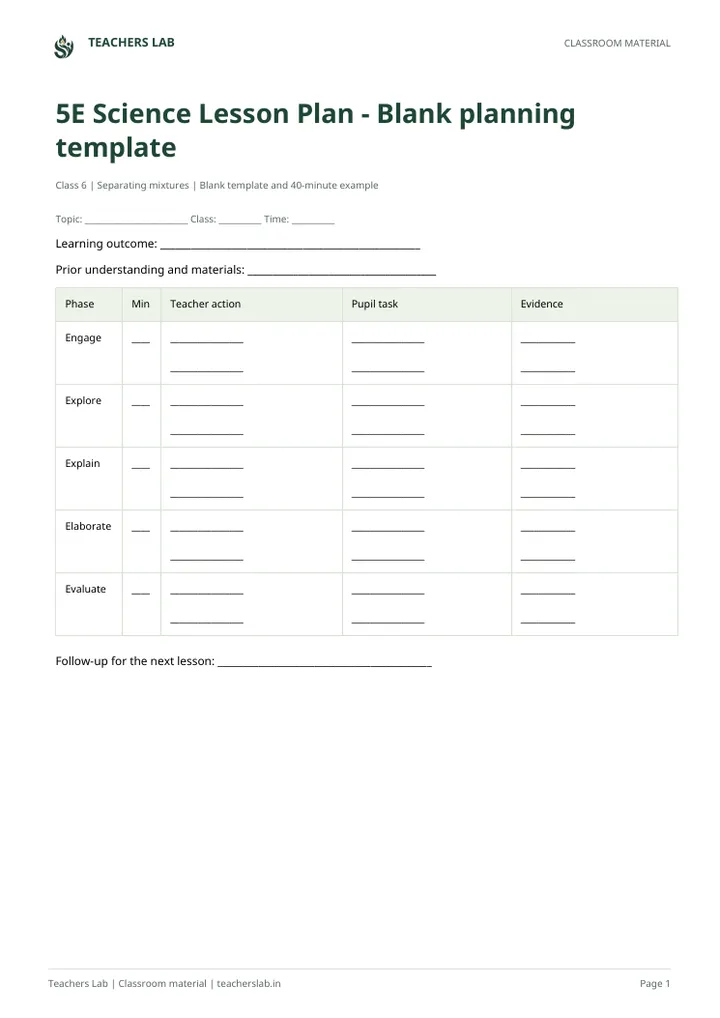
The Teachers Lab download starts with a blank planning grid. It then gives a 40-minute example for a Class 6 lesson on separating mixtures, followed by exit questions and suggested answers. The example uses observation cards and simple filtration; no heating activity is needed.
TEACHERS LAB MATERIAL · FILLED 40-MINUTE EXAMPLE
| Phase | Minutes | Teacher action | Pupil activity | Evidence |
|---|---|---|---|---|
| Engage | 5 | Show a drawing of muddy salt water. Ask: will a filter give us clean, salt-free water? | Predict the result and explain why. | Record predictions before teaching the separation terms. |
| Explore | 10 | Give groups prepared observation cards for settling, filtration and evaporation. Where available, let them filter a small sand-water mixture. | Compare what is retained and what passes through the filter. | Look for pupils distinguishing suspended material from a dissolved substance. |
| Explain | 10 | Connect the observations to sedimentation, decantation, filtration and evaporation. Explain why dissolved salt passes through an ordinary filter. | Revise an initial prediction using the new vocabulary. | Ask for an explanation linked to the observed material. |
| Elaborate | 10 | Present a new problem: recover dry salt from a sand-salt-water mixture. Use a prepared evaporation picture rather than a heating activity. | Propose and justify a sequence: filter out sand, then evaporate water from the filtrate. | Check that the chosen method matches the material to be recovered. |
| Evaluate | 5 | Use the three exit questions below. | Answer independently and explain one method choice. | Use the answers to decide whether dissolved and suspended materials need revisiting. |
Three exit questions
Why does dissolved salt remain after ordinary filtration?
Dissolved salt passes through the filter with the water; filtration separates the suspended sand.
How could you recover dry salt from the filtrate?
Evaporate the water to leave the salt behind.
Why should you filter the original sand-salt-water mixture before recovering the salt?
Filtering removes the insoluble sand so that it does not remain mixed with the recovered salt.
The PDF also includes a blank grid for your next lesson.
Why this example begins with a prediction
Ask, “Will a filter remove both the sand and the dissolved salt?” before teaching the method names. A prediction gives you something to revisit. If a pupil later changes their answer, ask what observation made them change it.
During the exploration, keep a record with two headings: What is retained? What passes through? Pupils can use an actual sand-water filtration observation or the supplied observations on cards. A useful discussion is why clear-looking water can still contain dissolved material.
Introduce the formal terms after pupils have evidence to discuss. Then offer a new separation problem. Pupils should choose the sequence because of the properties of the materials, not because they have memorised an order of words.
Keep the timing workable
Our example uses 5 + 10 + 10 + 10 + 5 = 40 minutes. That includes collecting initial ideas, working with observations and an independent exit response. Prepare cards and materials before the lesson so distribution does not use the whole exploration slot.
If pupils need longer to investigate, spread the sequence over two periods. Record where the class stopped and begin the next lesson with its observations. A short lesson should narrow the concept rather than rush every activity.
Use evidence throughout the lesson
An exit slip is useful, but so are the explanations you hear during pair work. In this example, listen for three distinctions: suspended sand versus dissolved salt; removing sand versus recovering salt; and naming a method versus explaining why it fits.
A pupil who writes “filtration” for every mixture needs another comparison. A pupil who gives the correct sequence but cannot say why salt passes through a filter needs to revisit the relationship between the material and the method.
Ask Teachers Lab for this structure
Open Lesson Plan and select the relevant topic or chapter pages. Set the class, subject, language and duration. Ask for the five phases in your brief or in a custom workspace refinement; there is no need to assume a separate 5E preset.
Organise this Class 6 Science lesson on separating mixtures as Engage, Explore, Explain, Elaborate and Evaluate. Keep the total at 40 minutes. For each phase, give the teacher action, pupil task and observable evidence. Begin with a prediction about sand-salt-water filtration. Use printed observations and a prepared evaporation picture instead of a heating activity. Include an exit slip and answers.
Review the scientific explanation and how the phases connect. Use Activities, Checks or Pacing to refine the plan, then save and export the version for class.
For a broader planning format, see board-aligned CBSE and ICSE lesson plans. To turn the sequence into a classroom deck, continue with creating a presentation from an NCERT chapter.
Common questions
Does every 5E lesson have to fit into 40 minutes?
No. Use a period or a sequence of periods that allows meaningful exploration and explanation. The 40-minute example focuses on a narrow concept.
Do all five phases need equal time?
No. Allocate time according to the task, pupil readiness and the evidence you need.
Can I use 5E without laboratory equipment?
Yes. Predictions, observation cards, teacher-provided data and carefully chosen classroom materials can support an inquiry sequence. Choose tasks suited to your teaching context.
YOUR NEXT CLASS
Create a version for your classroom.
Bring your topic or book pages, then review and refine the resource for your students.
Start in Teachers Lab