
THE PREPARATION NOTEBOOK / Lesson planning
Lesson Plan Format for CBSE and ICSE Teachers: Templates and Filled Examples
Plan a CBSE or ICSE lesson around the syllabus, textbook and evidence of learning. Download two Class 10 Science and Chemistry lesson-plan examples from Teachers Lab.
Teachers Lab material · Free sample download
Written with AI assistance for Teachers Lab. Review and adapt the classroom examples for your pupils.
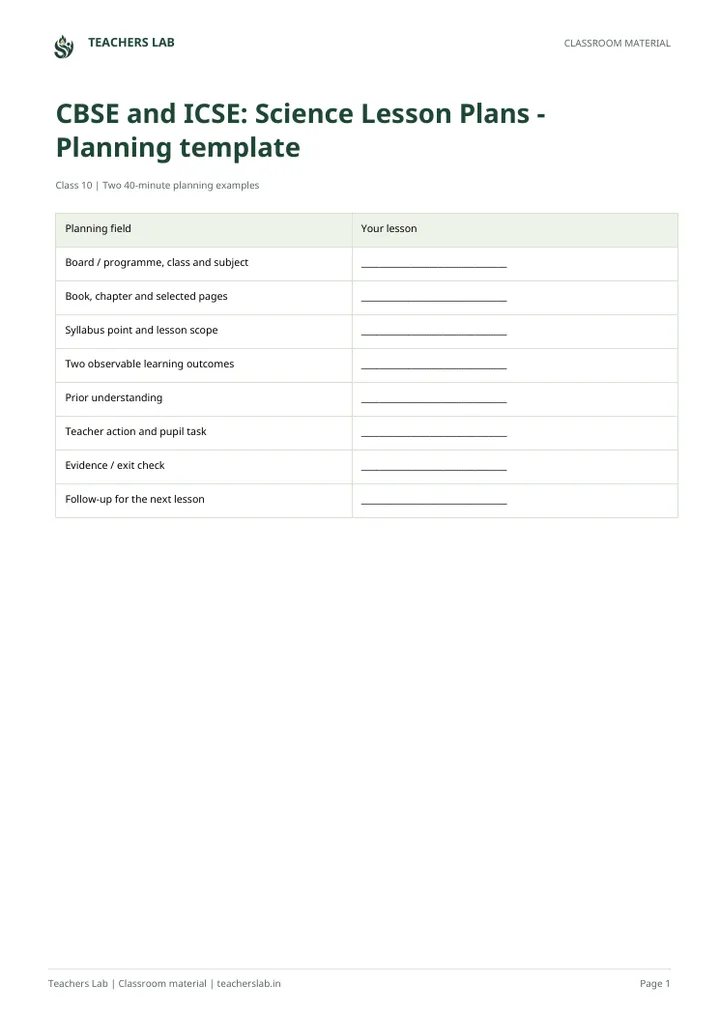
Start with the lesson’s scope
A board label on the first page is only a starting point. A useful lesson plan connects four things: the relevant syllabus statement, the pages or material being taught, a clear learning outcome and a task that shows whether pupils understood it.
Keep the subject and programme precise. Class 10 Science in CBSE and Class 10 Chemistry in ICSE can share a concept while differing in organisation, terminology and the examples your school expects. ICSE and ISC also refer to different stages; select the class and subject rather than treating the label as one universal syllabus.
Use CBSE’s current curriculum directory and the current ICSE syllabus from CISCE as your starting references. Then consult the school’s scheme of work and textbook. The examples here focus on acids, bases and neutralisation; they do not attempt to cover a whole chapter in one period.
A reusable lesson-plan format
Copy these fields into your planning notebook:
| Field | What to record |
|---|---|
| Class and subject | Board/programme, class, subject and language |
| Source and scope | Book, chapter, selected pages and the relevant syllabus point |
| Learning outcomes | Two or three things pupils should be able to do by the end |
| Prior understanding | Vocabulary or ideas needed before the main task |
| Lesson sequence | Time, teacher action, pupil task and materials |
| Evidence of learning | An explanation, diagram, calculation, practical observation or exit slip |
| Follow-up | Support for pupils who need another example; an extension for those ready to apply the idea |
Avoid an outcome such as “understand acids.” “Classify a solution from pH evidence and explain the choice” gives you something you can check.
Two filled planning examples
These are alternative starting points for a 40-minute period. Both use printed observations and discussion. Their emphasis is a planning choice for these examples, not a claim that a concept belongs exclusively to one board.
TEACHERS LAB MATERIAL · CBSE · 40 MINUTES
Class 10 Science: pH and neutralisation
Outcomes
- Classify solutions using pH evidence.
- Explain neutralisation using an example and a balanced equation.
- Justify a treatment for an acidic sample.
| Stage | Minutes | Teacher and pupil activity |
|---|---|---|
| Engage | 5 | Show printed pH cards: 3, 7 and 10. Ask which sample is acidic and what evidence supports the choice. |
| Investigate | 8 | Pairs classify pH cards and match supplied litmus observations. Record an initial explanation, not just an answer. |
| Explain | 10 | Connect the observations to hydrogen and hydroxide ions. Model HCl + NaOH -> NaCl + H2O and the meaning of neutralisation. |
| Apply | 12 | Give two soil pH values, 4.5 and 8.0. Ask which could be treated with limestone and why. Compare explanations as a class. |
| Check and close | 5 | Exit slip: choose one sample, cite its pH and explain the expected action of the treatment. Collect one response per pupil. |
What to check: Expected evidence: identifies pH 4.5 as acidic, links limestone to reducing acidity, and does not recommend the same treatment for pH 8.0.
TEACHERS LAB MATERIAL · ICSE · 40 MINUTES
Class 10 Chemistry: acids, alkalis and ions
Outcomes
- Relate acid and alkali properties to the ions in aqueous solution.
- Interpret supplied indicator observations.
- Represent neutralisation using a balanced equation.
| Stage | Minutes | Teacher and pupil activity |
|---|---|---|
| Recall | 5 | Ask pupils to distinguish a substance, a solution and an ion. Record everyday descriptions before introducing precise terms. |
| Interpret | 8 | Use printed indicator results for named dilute acid, alkali and neutral solutions. Ask pairs to explain their classifications. |
| Explain | 10 | Use the terminology in the current ICSE syllabus and the school textbook to connect aqueous acids, hydronium/hydrogen ions, alkalis and hydroxide ions. |
| Practise | 12 | Pupils explain a named acid-alkali reaction and balance HCl + NaOH -> NaCl + H2O. Ask them to connect ions with the observed change. |
| Evaluate | 5 | Exit slip: identify an acid or alkali from an observation, name the relevant ion and give a supporting explanation. |
What to check: Expected evidence: identifies the solution from the indicator evidence and correctly relates the property to ions in aqueous solution.
Adapt the material rather than changing only the heading
For the CBSE example, ask pupils to justify a choice using supplied pH evidence. For the ICSE example, make space for the ion terminology and representations used in the school’s current Chemistry text. The common core is the relationship between a solution’s properties, ions and the evidence provided.
A quick review is to draw a line from each outcome to a pupil task and then to a check. If “explain neutralisation” appears in the outcome, the exit task should ask for an explanation, not merely the spelling of the word.
Create the plan in Teachers Lab
Choose Lesson Plan. For a CBSE NCERT lesson, select From my books, choose the saved book and chapter, and select the exact pages. For an ICSE topic, choose From a topic, select ICSE, class, subject and language, and use the syllabus-unit selector when it is available. You can attach relevant page images for additional context.
Set the duration and teaching style in the lesson-plan options. Add the outcome and the pupil task you want. The board and class narrow the context; your selected material and brief define the lesson’s actual scope.
Create a 40-minute Class 10 ICSE Chemistry lesson on acids, alkalis and ions in aqueous solution. Include two observable outcomes, a short interpretation task using supplied indicator observations, a balanced neutralisation equation, likely misconceptions and a five-minute exit slip. Use the terminology in the selected syllabus unit and the attached school textbook pages.
In the workspace, use Activities, Checks and Pacing, or write a custom instruction. Review the revised timing, save the version and export the PDF. The book catalogue and curriculum-unit availability depend on the selected class and subject; an attached page image should be checked for legibility before generating.
Plan the follow-up while checking the answers
Look for patterns rather than counting only right answers. A pupil who selects the acidic sample but cannot explain the evidence may need another worked example. A pupil who balances the equation correctly but confuses ions with neutral atoms needs a different follow-up.
For an inquiry-based sequence, use the 5E Science lesson-plan template. For an actual saved-book Mathematics example, see the Class 11 Sets lesson plan.
Common questions
Can I use one lesson-plan format for CBSE and ICSE?
Yes. Keep the planning structure, but adapt the scope, terminology, textbook references, tasks and assessment evidence to the relevant board, class and subject.
Should I cover a whole chapter in a single lesson?
Only if the scope and pupil readiness make that realistic. The downloadable examples focus on a small set of ideas for one 40-minute period.
Does Teachers Lab have the same books for every board?
The built-in library is NCERT. For ICSE topics, use the board/class/subject context, available syllabus units and relevant page images as needed.
YOUR NEXT CLASS
Create a version for your classroom.
Bring your topic or book pages, then review and refine the resource for your students.
Start in Teachers Lab