
THE PREPARATION NOTEBOOK / Assessment
Class 10 Science Competency-Based Questions: Examples, Answers and How to Create Them
Use six Class 10 Science competency-based questions with worked answers and a free 16-mark PDF. Learn how to build evidence, application and reasoning into classroom assessment.
Teachers Lab material · Free sample download
Written with AI assistance for Teachers Lab. Review and adapt the classroom examples for your pupils.
What makes a question competency-based?
A long paragraph is not enough. A useful question asks a pupil to use an idea: interpret an observation, choose a method, explain a result, apply a relationship or evaluate a claim. The context should give the pupil something meaningful to work with.
For example, “Define a displacement reaction” checks recall. Asking why an iron nail develops a copper coating in copper sulphate solution asks the pupil to connect an observation, the reactivity series and an equation. Neither question needs difficult language.
CBSE’s competency-based teacher resources provide assessment and classroom-planning material. Use them alongside the current Class 10 Science syllabus when deciding the scope of a school assessment. The examples below are Teachers Lab classroom material spanning several taught topics.
Six questions, with suggested answers
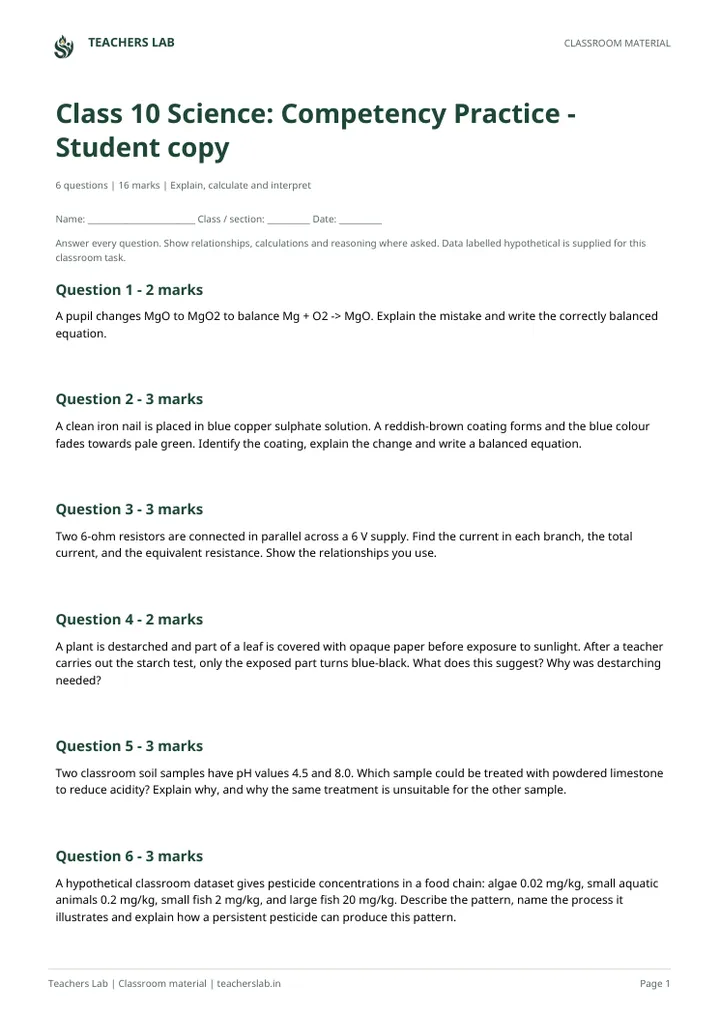
Download the packet for a student copy followed by the teacher key. Each example below includes the evidence to look for; open the suggested answer after trying the question.
TEACHERS LAB CLASSROOM MATERIAL · 16 MARKS
QUESTION 1 · 2 MARKS · Chemical reactions
Balancing without changing the substance
A pupil changes MgO to MgO2 to balance Mg + O2 -> MgO. Explain the mistake and write the correctly balanced equation.
Suggested answer and marking points
- Changing a chemical formula changes the substance; balance by changing coefficients only.
- 2 Mg + O2 -> 2 MgO. There are two magnesium atoms and two oxygen atoms on each side.
QUESTION 2 · 3 MARKS · Chemical reactions
Explain what the nail tells you
A clean iron nail is placed in blue copper sulphate solution. A reddish-brown coating forms and the blue colour fades towards pale green. Identify the coating, explain the change and write a balanced equation.
Suggested answer and marking points
- The coating is copper deposited on the nail.
- Iron displaces copper because iron is more reactive; iron(II) sulphate forms in solution.
- Fe + CuSO4 -> FeSO4 + Cu.
QUESTION 3 · 3 MARKS · Electricity
Reason from a circuit
Two 6-ohm resistors are connected in parallel across a 6 V supply. Find the current in each branch, the total current, and the equivalent resistance. Show the relationships you use.
Suggested answer and marking points
- Each branch has 6 V across it, so I = V/R = 6/6 = 1 A in each branch.
- Total current = 1 + 1 = 2 A.
- Equivalent resistance = V/I(total) = 6/2 = 3 ohms.
QUESTION 4 · 2 MARKS · Life processes
Interpret a covered-leaf result
A plant is destarched and part of a leaf is covered with opaque paper before exposure to sunlight. After a teacher carries out the starch test, only the exposed part turns blue-black. What does this suggest? Why was destarching needed?
Suggested answer and marking points
- The exposed part produced starch while the covered part did not, supporting the need for light in photosynthesis under these conditions.
- Destarching removes previously stored starch so that the result can be related to the treatment.
QUESTION 5 · 3 MARKS · Acids, bases and salts
Choose a treatment from pH evidence
Two classroom soil samples have pH values 4.5 and 8.0. Which sample could be treated with powdered limestone to reduce acidity? Explain why, and why the same treatment is unsuitable for the other sample.
Suggested answer and marking points
- Choose the pH 4.5 sample, which is acidic.
- Calcium carbonate in limestone reacts with acid and can reduce the soil acidity.
- The pH 8.0 sample is alkaline; adding a material used to reduce acidity does not address that condition.
QUESTION 6 · 3 MARKS · Our environment
Read a food-chain data table
A hypothetical classroom dataset gives pesticide concentrations in a food chain: algae 0.02 mg/kg, small aquatic animals 0.2 mg/kg, small fish 2 mg/kg, and large fish 20 mg/kg. Describe the pattern, name the process it illustrates and explain how a persistent pesticide can produce this pattern.
Suggested answer and marking points
- Concentration increases at successive trophic levels; the large fish have the highest value.
- The increasing concentration along the food chain illustrates biomagnification.
- Persistent pesticides may remain in organisms and pass to predators through feeding; repeated intake from contaminated prey can increase their concentration.
Build your own question in five steps
- Choose the learning outcome. Write a task you can observe: explain a displacement, interpret a pH value or calculate a branch current.
- Give just enough evidence. Use a short observation, a labelled diagram or a small data table. State units and conditions that affect the answer.
- Ask for a decision and a reason. “Which sample?” can be followed by “Use the pH evidence to justify your choice.”
- Write the answer before finalising the question. If the explanation needs information the pupil has not been given or taught, revise the prompt.
- Allocate marks to distinct evidence. Credit the identification, the reasoning and the calculation separately where appropriate. Accept equivalent scientifically correct explanations.
A useful edit is to remove sentences one by one. If a sentence does not help the pupil understand the situation or work out an answer, it probably does not need to be there.
Create a version for your class in Teachers Lab
Open Worksheet or HOTS. For an NCERT-based sheet, choose From my books, select the book and chapter, then select the relevant pages. Use only the pages covering the ideas you want to assess. The mixed-topic packet above is better split into separate chapter-based generations if your class has not covered every topic.
Alternatively, choose From a topic, set Class 10, Science, CBSE and your teaching language, and name the concepts. In the resource options, choose the difficulty and question mix and include an answer key. The HOTS tool is useful when you specifically want higher-order tasks; a well-designed application question does not always need to be a difficult HOTS question.
Try this brief:
Create six Class 10 Science questions on displacement reactions. Use short observations and familiar situations. Require explanations using the reactivity series and balanced equations. Give a 12-mark total and a numbered answer key with separate marking points. Stay within the selected chapter pages.
Check the output, then use Simplify, Examples or a custom instruction to adapt it. Save the version you intend to use and export the PDF.
Before using the worksheet
Check chemical formulae, equations, units and the relationship between each question and its answer. Make sure hypothetical data is labelled as such. Decide which errors lose a method mark and which lose an accuracy mark; use the same rule for the whole class.
For a complete classroom test, continue with the question-paper blueprint and marking-scheme guide. For a single-chapter walkthrough, see creating an NCERT worksheet with answers.
Common questions
Are competency-based questions always difficult?
No. A straightforward question can assess whether a pupil can use a concept. Difficulty depends on the context, number of reasoning steps and support provided.
Is a case-based question automatically competency-based?
No. A case can still lead only to recall questions. Look at what the pupil must do with the information.
Can I download the questions without signing in?
Yes. The Teachers Lab practice packet and teacher key are available as a free PDF. Sign in to create your own version; account usage limits apply.
YOUR NEXT CLASS
Create a version for your classroom.
Bring your topic or book pages, then review and refine the resource for your students.
Start in Teachers Lab