
THE PREPARATION NOTEBOOK / Question papers
How to Prepare a CBSE Question Paper With a Blueprint and Marking Scheme
Build a balanced classroom assessment with a question-paper blueprint, explicit marking points and a checking workflow. Includes a free 20-mark Science paper and teacher key.
Teachers Lab material · Free sample download
Written with AI assistance for Teachers Lab. Review and adapt the classroom examples for your pupils.
Begin with the purpose of the paper
A chapter check, a unit test and a full-length board practice paper need different coverage and timing. Write the purpose before deciding the question count. List only the content that has been taught and identify the learning outcomes you need to assess.
For a full-length Class 10 Science paper, consult the CBSE 2026–27 sample paper and marking scheme. The published Science sample has 80 marks, three hours and 39 questions organised into Biology, Chemistry and Physics sections. Use that current structure when planning full-length practice.
The downloadable Teachers Lab material below is a 20-mark, 45-minute classroom assessment across four taught areas. It demonstrates the planning method at a smaller scale. You can apply the same method to the coverage and format your school requires.
What belongs in a blueprint?
A blueprint connects content, the task being assessed and the marks. It lets you spot gaps before writing a long paper.
| Planning question | What to check |
|---|---|
| Which content is being sampled? | Every question belongs to a taught topic or outcome |
| What must pupils do? | Recall, explain, interpret, calculate or justify |
| How many marks are available? | Each marking point can be awarded consistently |
| Is the paper balanced? | One easy-to-write topic does not dominate by accident |
| Can it be completed in time? | Include reading, working, diagrams and checking |
| What happens with an internal choice? | Alternatives have comparable scope and demand; do not count both towards the attempted total |
The current Class 10 Science syllabus gives annual-examination unit weights. Those annual weights guide a full-course paper; a short test should reflect its own taught scope rather than automatically copying a full-year distribution.
Worked 20-mark example
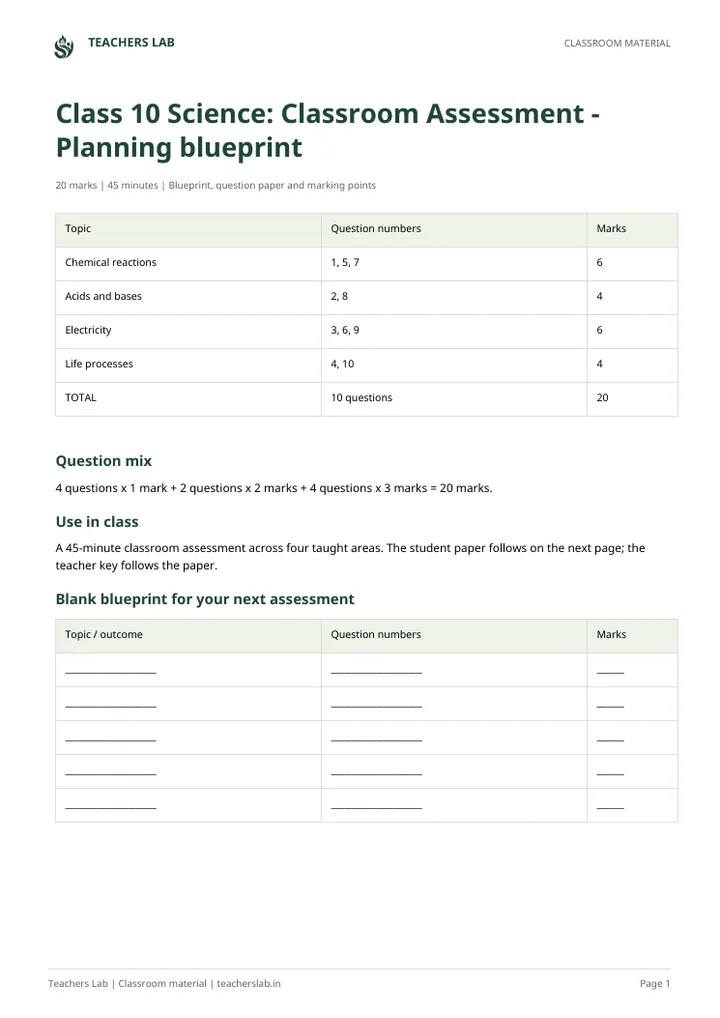
The packet contains the filled blueprint, the student paper and a separate teacher-key section. Its question mix is four one-mark MCQs, two two-mark questions and four three-mark questions: 4 + 4 + 12 = 20 marks.
TEACHERS LAB CLASSROOM MATERIAL · 20 MARKS
| Topic | Question numbers | Marks |
|---|---|---|
| Chemical reactions | 1, 5, 7 | 6 |
| Acids and bases | 2, 8 | 4 |
| Electricity | 3, 6, 9 | 6 |
| Life processes | 4, 10 | 4 |
QUESTION 1 · 1 MARK
An iron nail develops a copper coating in copper sulphate solution. Which reaction type best describes this? A. Decomposition B. Displacement C. Combination D. Neutralisation
Suggested answer and marking points
- B. Displacement.
QUESTION 2 · 1 MARK
Which sample would turn blue litmus red? A. pH 3 B. pH 7 C. pH 9 D. pH 11
Suggested answer and marking points
- A. The pH 3 sample is acidic.
QUESTION 3 · 1 MARK
A wire is replaced with one of the same material and cross-sectional area but twice the length, at the same temperature. Its resistance becomes: A. half B. unchanged C. twice D. four times
Suggested answer and marking points
- C. Twice, using R = rho L/A.
QUESTION 4 · 1 MARK
In a covered-leaf investigation, which preparation helps ensure that detected starch was made during the investigation? A. Watering twice B. Destarching C. Adding salt D. Removing the roots
Suggested answer and marking points
- B. Destarching.
QUESTION 5 · 2 MARKS
Balance Mg + O2 -> MgO. Explain why changing MgO to MgO2 is not a valid way of balancing this reaction.
Suggested answer and marking points
- 2 Mg + O2 -> 2 MgO.
- Changing the formula changes the identity of the substance; balancing uses coefficients.
QUESTION 6 · 2 MARKS
A 3-ohm resistor is connected across 6 V. Calculate the current. What is the current if the resistance becomes 6 ohms while the voltage stays the same?
Suggested answer and marking points
- I = 6/3 = 2 A.
- I = 6/6 = 1 A.
QUESTION 7 · 3 MARKS
An iron nail in copper sulphate solution develops a reddish-brown deposit. Name the deposit, explain why the reaction occurs and write the balanced equation.
Suggested answer and marking points
- The deposit is copper.
- Iron is more reactive than copper and displaces it from copper sulphate.
- Fe + CuSO4 -> FeSO4 + Cu.
QUESTION 8 · 3 MARKS
Dilute hydrochloric acid is gradually added to dilute sodium hydroxide. The pH falls from 11 towards 7. Identify the reacting ions, name the salt formed and explain what happens if excess acid is added.
Suggested answer and marking points
- Hydrogen ions react with hydroxide ions to form water: H+ + OH- -> H2O.
- Sodium chloride is the salt formed.
- Excess acid leaves excess hydrogen ions, so the solution becomes acidic and its pH falls below 7.
QUESTION 9 · 3 MARKS
A 6-ohm resistor and a 3-ohm resistor are connected in parallel across 6 V. Calculate both branch currents. Hence find the total current and equivalent resistance.
Suggested answer and marking points
- Current through the 6-ohm branch = 6/6 = 1 A.
- Current through the 3-ohm branch = 6/3 = 2 A.
- Total current = 3 A and equivalent resistance = 6/3 = 2 ohms.
QUESTION 10 · 3 MARKS
In a hypothetical investigation, otherwise similar plants lose 6 g of water per hour in dry air and 2 g per hour in humid air. Which condition has higher transpiration? Explain the pattern and name one variable that should be controlled.
Suggested answer and marking points
- Transpiration is higher in dry air.
- A larger water-vapour concentration difference between the leaf and surrounding dry air favours evaporation and diffusion.
- Accept a relevant control such as leaf area, temperature, light intensity or air movement.
Write the marking scheme as you write the question
Break a three-mark response into distinct evidence. For the iron-nail question, the key awards a point each for identifying copper, explaining displacement using relative reactivity, and writing the balanced equation.
For a numerical, decide what earns a method mark and where units matter. The parallel-resistor item first checks the branch currents, then the combined result. Make the scoring convention explicit before marking the class. Credit an equivalent valid method; avoid awarding the same reasoning twice.
Read every question alongside its answer. Check that the wording supplies the needed values, that the requested number of reasons matches the marking points, and that no model answer assumes an unseen diagram.
Build the paper in Teachers Lab
Open Question Paper. Choose the topic route or saved book pages, then set the board, class, subject, language, marks, duration and available paper-specific options. In the brief, describe the coverage and the blueprint you want rather than asking for “important questions.”
Prepare a 20-mark Class 10 CBSE Science classroom test for 45 minutes. Cover Chemical Reactions for 6 marks, Acids and Bases for 4, Electricity for 6 and Life Processes for 4. Include four 1-mark MCQs, two 2-mark questions and four 3-mark questions. Number questions consistently and provide a blueprint and separate marking points. Use hypothetical data where needed and label it clearly.
The generated paper is a working draft. Check that the totals reconcile and that the coverage actually follows the brief, then refine specific questions in the workspace. Export the version you have checked.
Run three checks before printing
- Content check: every item is within the chosen scope; facts, formulae and diagrams are correct.
- Arithmetic check: blueprint totals, question marks, section marks and attempted marks agree. Internal choices should not inflate the score.
- Classroom check: instructions are clear, answer space is adequate and the timing is realistic for your pupils.
For question-writing examples, see the Class 10 competency-based question guide. For the lesson that comes before the test, use the CBSE and ICSE planning guide.
Common questions
Is a blueprint the same as a marking scheme?
No. A blueprint plans coverage and marks across the paper. A marking scheme explains the evidence that earns marks for each question.
Can I use the 20-mark example as a full-length paper?
Use it as a short classroom assessment. For full-length practice, build out the coverage and follow the current sample-paper instructions and your school requirements.
How should I count internal-choice questions?
Count the marks a pupil can attempt, not the sum of both alternatives. Check that the alternatives have comparable demands.
YOUR NEXT CLASS
Create a version for your classroom.
Bring your topic or book pages, then review and refine the resource for your students.
Start in Teachers Lab