
THE PREPARATION NOTEBOOK / Question papers
CBSE Class 12 Chemistry Question Paper With Marking Scheme: Pre-Board Practice
Use an original 70-mark Class 12 Chemistry practice paper, separate marking scheme and unit blueprint. Learn how to review an AI-assisted pre-board assessment.
Teachers Lab material · Free sample download
Written with AI assistance for Teachers Lab. Original classroom examples are provided for teachers to review, adapt and use with their own teaching judgement.
A Chemistry question paper needs a plan for marking
A question paper can look balanced while placing too many marks on one unit or giving too little information for a numerical answer. Let’s begin with a complete original paper and inspect the relationship between questions, marks and expected reasoning.
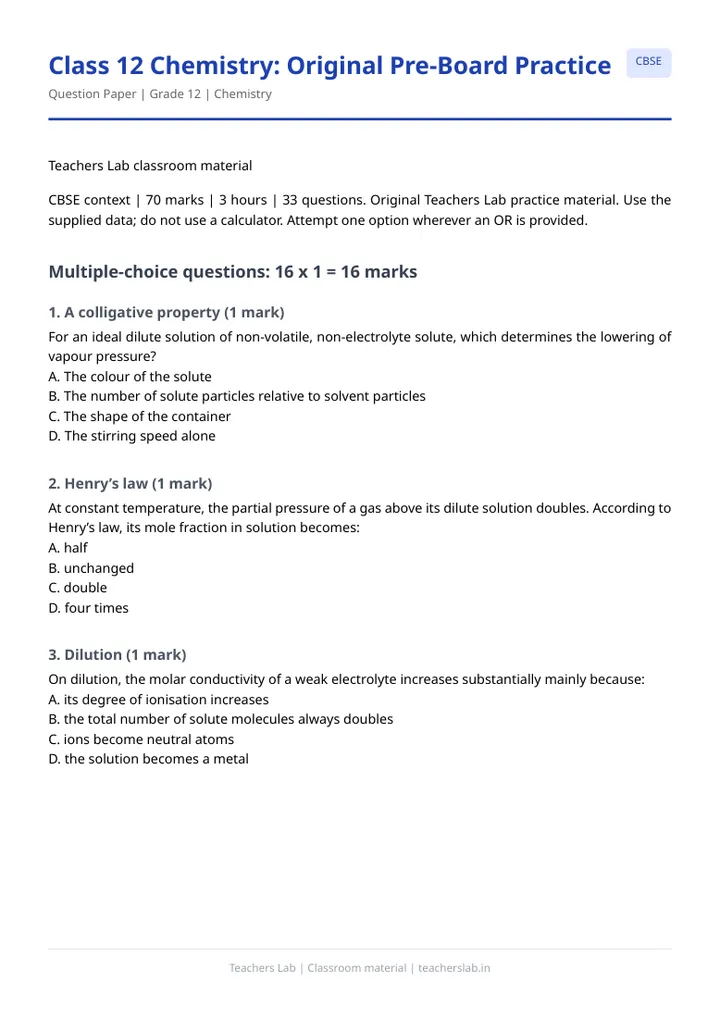
This CBSE Class 12 Chemistry pre-board practice paper has 33 questions, 70 marks and a suggested duration of three hours. It uses the section structure shown in the official CBSE 2026–27 Chemistry sample paper. The questions here are Teachers Lab teaching material; they are not an official board paper, prediction or guarantee of examination coverage.
Download the paper and marking scheme
Keep the student paper separate from the teacher marking scheme and blueprint. The key contains one marking point per mark and answers for the internal alternatives. Award either side of an OR question, not both.
| Section | Questions | Marks per question | Section total |
|---|---|---|---|
| A | 1–16 | 1 | 16 |
| B | 17–21 | 2 | 10 |
| C | 22–28 | 3 | 21 |
| D | 29–30 | 4 | 8 |
| E | 31–33 | 5 | 15 |
The sum is 70. The unit blueprint below describes this original sample's allocation; compare it with the syllabus and assessment requirements your school is currently using.
TEACHERS LAB CLASSROOM MATERIAL · 70 MARKS
| Topic | Question numbers | Marks |
|---|---|---|
| Solutions | 1, 2, 17, 22 | 7 |
| Electrochemistry | 3, 23, 31 | 9 |
| Chemical Kinetics | 4, 5, 18, 24 | 7 |
| d- and f-Block Elements | 6, 7, 19, 25 | 7 |
| Coordination Compounds | 8, 9, 20, 26 | 7 |
| Haloalkanes and Haloarenes | 10, 21, 27 | 6 |
| Alcohols, Phenols and Ethers | 11, 32 | 6 |
| Aldehydes, Ketones and Carboxylic Acids | 12, 28, 29 | 8 |
| Amines | 13, 33 | 6 |
| Biomolecules | 14, 15, 16, 30 | 7 |
QUESTION 1 · 1 MARK
A colligative property
Section A: Multiple-choice questions: 16 x 1 = 16 marks
For an ideal dilute solution of non-volatile, non-electrolyte solute, which determines the lowering of vapour pressure? A. The colour of the solute B. The number of solute particles relative to solvent particles C. The shape of the container D. The stirring speed alone
Suggested answer and marking points
- B. A colligative property depends on the relative number of solute particles under the stated conditions.
QUESTION 2 · 1 MARK
Henry’s law
At constant temperature, the partial pressure of a gas above its dilute solution doubles. According to Henry’s law, its mole fraction in solution becomes: A. half B. unchanged C. double D. four times
Suggested answer and marking points
- C. p = KH x, so doubling p doubles x when KH stays constant.
QUESTION 3 · 1 MARK
Dilution
On dilution, the molar conductivity of a weak electrolyte increases substantially mainly because: A. its degree of ionisation increases B. the total number of solute molecules always doubles C. ions become neutral atoms D. the solution becomes a metal
Suggested answer and marking points
- A. Dilution favours ionisation of a weak electrolyte, increasing the fraction present as ions.
QUESTION 4 · 1 MARK
Rate constant units
The rate constant of a first-order reaction has units: A. mol L^-1 s^-1 B. L mol^-1 s^-1 C. s^-1 D. mol^2 L^-2 s^-1
Suggested answer and marking points
- C. For rate = k[A], k has units of inverse time.
QUESTION 5 · 1 MARK
A half-life
For a first-order reaction at fixed temperature, its half-life is: A. directly proportional to initial concentration B. independent of initial concentration C. zero at low concentration D. always equal to the reaction time
Suggested answer and marking points
- B. t1/2 = 0.693/k, independent of the initial concentration.
QUESTION 6 · 1 MARK
A colourless ion
Which aqueous ion is generally colourless because it has a d0 configuration? Atomic numbers: Sc 21, Ti 22, V 23, Cu 29. A. Ti3+ B. V3+ C. Cu2+ D. Sc3+
Suggested answer and marking points
- D. Sc3+ is d0, so it has no d-d transition responsible for these characteristic colours.
QUESTION 7 · 1 MARK
Lanthanide contraction
The gradual decrease in lanthanoid ionic radii mainly results from: A. excellent shielding by 4f electrons B. poor shielding by 4f electrons as nuclear charge increases C. loss of all protons D. identical nuclear charge in every lanthanoid
Suggested answer and marking points
- B. Poor 4f shielding permits increasing effective nuclear charge to contract the electron cloud.
QUESTION 8 · 1 MARK
An oxidation state
What is the oxidation state of cobalt in [Co(NH3)5Cl]Cl2? A. +1 B. +2 C. +3 D. +5
Suggested answer and marking points
- C. Two outer chloride ions imply a +2 complex ion; the inner chlorido ligand is -1, giving cobalt +3.
QUESTION 9 · 1 MARK
Geometrical isomerism
Which square-planar complex can show cis and trans isomerism? A. [Pt(NH3)2Cl2] B. [PtCl4]2- C. [Pt(NH3)4]2+ D. [Ni(CO)4], tetrahedral
Suggested answer and marking points
- A. The two pairs of ligands can occupy adjacent or opposite positions in square-planar [Pt(NH3)2Cl2].
QUESTION 10 · 1 MARK
SN1 reactivity
Under comparable conditions in a suitable polar protic solvent, which is most likely to react fastest by SN1? A. Chloromethane B. Chloroethane C. 1-Chloropropane D. 2-Chloro-2-methylpropane
Suggested answer and marking points
- D. The tertiary carbocation intermediate is more stable than the corresponding primary or methyl carbocation.
QUESTION 11 · 1 MARK
A phenol test
Which sample typically gives a violet colour with neutral ferric chloride solution? A. Ethanol B. Phenol C. Ethoxyethane D. Propan-2-ol
Suggested answer and marking points
- B. Phenol gives the characteristic ferric chloride colour under suitable test conditions.
QUESTION 12 · 1 MARK
Tollens’ reagent
Which compound normally gives a positive Tollens’ test? A. Propanone B. Ethanal C. Ethanoic acid D. Ethoxyethane
Suggested answer and marking points
- B. Ethanal is an aldehyde and reduces Tollens’ reagent to silver.
QUESTION 13 · 1 MARK
Basicity
Which is least basic among the following in aqueous solution? A. Ethylamine B. Methylamine C. Ammonia D. Aniline
Suggested answer and marking points
- D. Delocalisation of the nitrogen lone pair into the aromatic ring reduces its availability for protonation in aniline.
QUESTION 14 · 1 MARK
A reducing sugar
Which is a reducing sugar? A. Sucrose B. Glucose C. Starch, as a bulk polysaccharide D. Cellulose, as a bulk polysaccharide
Suggested answer and marking points
- B. Glucose has a reducing form in equilibrium and gives standard reducing-sugar tests.
QUESTION 15 · 1 MARK
A linkage
Monosaccharide units in a disaccharide connect through a: A. peptide linkage B. glycosidic linkage C. metallic bond D. phosphodiester linkage
Suggested answer and marking points
- B. A glycosidic linkage joins the monosaccharide units.
QUESTION 16 · 1 MARK
Protein structure
The alpha-helix of a protein is stabilised mainly by: A. hydrogen bonds along the peptide chain B. new peptide bonds between every turn C. ionic bonds with sodium metal D. glycosidic linkages
Suggested answer and marking points
- A. Hydrogen bonding stabilises this secondary structure.
QUESTION 17 · 2 MARKS
An ideal binary solution
Section B: Very short answers: 5 x 2 = 10 marks
At a fixed temperature, an ideal solution contains liquids A and B with x(A) = 0.40. The vapour pressures of pure A and B are 100 kPa and 60 kPa. Calculate the total vapour pressure.
OR
An ideal dilute solution contains a non-volatile non-electrolyte. Explain why its vapour pressure is lower than that of pure solvent at the same temperature, and state Raoult’s law for the solvent.
Suggested answer and marking points
- p(A) = 0.40 x 100 = 40 kPa and p(B) = 0.60 x 60 = 36 kPa.
- Total vapour pressure = 40 + 36 = 76 kPa.
Alternative answer
- The solvent mole fraction is below 1, so its partial pressure is lower.
- p(solvent) = x(solvent) p0(solvent).
QUESTION 18 · 2 MARKS
Two half-lives
A first-order reaction has a half-life of 20 minutes. How long does it take for 75% of the initial reactant to be consumed? Explain.
Suggested answer and marking points
- After one half-life 50% remains; after two, 25% remains, corresponding to 75% consumption.
- Time = 2 x 20 = 40 minutes.
QUESTION 19 · 2 MARKS
A reduction half-equation
Write the reduction half-equation for permanganate ion to Mn2+ in acidic solution. State the change in manganese oxidation state.
Suggested answer and marking points
- MnO4- + 8H+ + 5e- → Mn2+ + 4H2O.
- Manganese changes from +7 to +2, gaining five electrons per ion.
QUESTION 20 · 2 MARKS
Name the complex
Give the IUPAC name of [Co(NH3)5Cl]Cl2 and show how you find the oxidation state of cobalt.
Suggested answer and marking points
- The complex ion is +2. With one inner Cl- and neutral NH3 ligands, cobalt is +3.
- Pentaamminechloridocobalt(III) chloride.
QUESTION 21 · 2 MARKS
Aryl and alkyl halides
Explain two reasons why chlorobenzene is less reactive than chloroethane towards ordinary nucleophilic substitution.
OR
For bromoethane, state the product with aqueous KOH and the product with alcoholic KOH on heating.
Suggested answer and marking points
- Resonance gives the aryl C-Cl bond partial double-bond character, making cleavage more difficult.
- The carbon bearing chlorine is sp2-hybridised, giving a shorter, stronger C-Cl bond than in the comparable alkyl chloride.
Alternative answer
- Aqueous KOH gives ethanol through substitution.
- Alcoholic KOH on heating gives ethene through elimination.
QUESTION 22 · 3 MARKS
Osmotic pressure
Section C: Short answers: 7 x 3 = 21 marks
A solution contains 0.010 mol of glucose in 1.00 L of solution at 298 K. Treat it as ideal and glucose as a non-electrolyte. Calculate its osmotic pressure. Use R = 0.0821 L atm mol^-1 K^-1.
Suggested answer and marking points
- Molar concentration c = 0.010 mol L^-1.
- For a non-electrolyte, osmotic pressure pi = cRT.
- pi = 0.010 x 0.0821 x 298 = 0.244658 atm, approximately 0.245 atm.
QUESTION 23 · 3 MARKS
A non-standard cell
For Zn(s) | Zn2+(0.10 M) || Cu2+(1.0 M) | Cu(s) at 298 K, E0(cell) = 1.10 V. Find E(cell). Use E = E0 - (0.0591/n) log10 Q. State n and Q.
Suggested answer and marking points
- The reaction is Zn + Cu2+ → Zn2+ + Cu, so n = 2.
- Q = [Zn2+]/[Cu2+] = 0.10. Pure solids do not appear in Q.
- E = 1.10 - (0.0591/2)(-1) = 1.12955 V, approximately 1.130 V.
QUESTION 24 · 3 MARKS
Concentration and time
A reaction has [A] = 0.80 mol L^-1 at 0 min, 0.40 at 10 min and 0.20 at 20 min. The data follow first-order kinetics. Calculate k and the time for 90% consumption from the initial concentration. Use ln 2 = 0.693 and ln 10 = 2.303.
Suggested answer and marking points
- The constant 10-minute half-life is consistent with the stated first-order model.
- k = 0.693/10 = 0.0693 min^-1.
- For 90% consumption, [A]0/[A] = 10, so t = 2.303/0.0693 = 33.2 min approximately.
QUESTION 25 · 3 MARKS
Configurations and radii
Explain: (a) Mn2+ resists oxidation to Mn3+ more than its simple charge might suggest; (b) Fe3+ has a half-filled d configuration; (c) Zr and Hf have similar radii. Atomic numbers: Mn 25, Fe 26.
Suggested answer and marking points
- Mn2+ has a stable half-filled 3d5 configuration; forming Mn3+ removes an electron from it.
- Fe3+ is 3d5 after losing the two 4s electrons and one 3d electron.
- Lanthanoid contraction reduces the size of Hf, making its radius close to that of Zr.
QUESTION 26 · 3 MARKS
Ligands and magnetism
Compare [NiCl4]2- and [Ni(CN)4]2- in terms of nickel oxidation state, geometry and unpaired electrons using the usual valence-bond description. Atomic number Ni = 28.
Suggested answer and marking points
- Both contain Ni2+, with a 3d8 configuration.
- Cl- is a weak-field ligand: [NiCl4]2- is tetrahedral (sp3) and has two unpaired electrons.
- CN- is a strong-field ligand: [Ni(CN)4]2- is square-planar (dsp2) and diamagnetic with no unpaired electrons.
QUESTION 27 · 3 MARKS
Substitution and stereochemistry
(a) Write the product when bromoethane reacts with aqueous KOH. (b) Write the product with alcoholic KOH on heating. (c) Explain inversion of configuration in an SN2 reaction at a chiral carbon.
Suggested answer and marking points
- CH3CH2Br + KOH(aq) → CH3CH2OH + KBr.
- CH3CH2Br + KOH(alc), heat → CH2=CH2 + KBr + H2O.
- Backside attack and simultaneous leaving-group departure invert the arrangement at the reacting chiral centre.
QUESTION 28 · 3 MARKS
Three unlabelled samples
Three samples contain ethanal, propanone and ethanoic acid, separately. Describe a sequence of tests to identify them. State what you observe and avoid treating the iodoform test as unique to propanone.
Suggested answer and marking points
- Sodium hydrogencarbonate gives effervescence of CO2 with ethanoic acid, identifying the acid.
- Of the remaining carbonyl samples, ethanal gives a silver mirror with Tollens’ reagent; propanone does not under usual test conditions.
- The remaining sample is propanone; its positive iodoform test is consistent with a methyl ketone. Ethanal also gives that test, so it is not unique to propanone.
QUESTION 29 · 4 MARKS
Case study: changing a functional group
Section D: Case-based questions: 2 x 4 = 8 marks
A teacher compares related compounds in a reaction sequence. Controlled oxidation of ethanol gives compound P; further oxidation gives Q. P reacts with methylmagnesium bromide followed by hydrolysis to give R. P can also be reduced with NaBH4. (a) Name P. (b) Name Q. (c) Name R and classify its alcohol group. (d) Name the NaBH4 reduction product of P.
Suggested answer and marking points
- P is ethanal.
- Q is ethanoic acid.
- R is propan-2-ol, a secondary alcohol.
- Reduction of ethanal with NaBH4 gives ethanol.
QUESTION 30 · 4 MARKS
Case study: sugars and proteins
A school laboratory uses sucrose solutions before and after acid hydrolysis, a peptide model and a diagram of heated egg protein. Answer each independent question. (a) Name the two monosaccharides formed on sucrose hydrolysis. (b) Explain why sucrose is non-reducing but its hydrolysis products can give reducing-sugar tests. (c) Name the linkage joining amino acids in a peptide. (d) Describe the structural change in protein denaturation without claiming that ordinary denaturation necessarily breaks peptide bonds.
Suggested answer and marking points
- Hydrolysis yields glucose and fructose.
- Both anomeric centres participate in sucrose’s glycosidic linkage; hydrolysis frees reducing forms of the monosaccharides under the relevant test conditions.
- A peptide (amide) linkage, -CO-NH-, joins the amino acid units.
- Denaturation disrupts secondary/tertiary organisation and biological function; the primary peptide sequence generally remains intact.
QUESTION 31 · 5 MARKS
A zinc-copper cell and electrolysis
Section E: Long answers: 3 x 5 = 15 marks
(a) Write the anode half-equation and cathode half-equation for a standard Zn-Cu galvanic cell. (b) Calculate E0(cell) from E0(Cu2+/Cu) = +0.34 V and E0(Zn2+/Zn) = -0.76 V. (c) Calculate Delta G0 per mole of cell reaction. (d) In a separate Cu2+ electrolysis, what mass of copper deposits when 1930 C passes at 100% current efficiency? Use F = 96500 C mol^-1 and M(Cu) = 63.5 g mol^-1.
OR
For a standard Zn-Cu cell use E0 = 1.10 V, n = 2 and F = 96500 C mol^-1. (a) State the direction of electron flow through the wire. (b) Explain the role of the salt bridge. (c) Calculate Delta G0. (d) State how E changes when [Zn2+] increases while [Cu2+] stays fixed. (e) State E at equilibrium.
Suggested answer and marking points
- Anode: Zn → Zn2+ + 2e-.
- Cathode: Cu2+ + 2e- → Cu.
- E0(cell) = 0.34 - (-0.76) = 1.10 V.
- Delta G0 = -nFE0 = -2 x 96500 x 1.10 = -212300 J mol^-1 = -212.3 kJ mol^-1.
- m = MQ/(nF) = 63.5 x 1930/(2 x 96500) = 0.635 g.
Alternative answer
- Electrons flow from zinc to copper through the external wire.
- The salt bridge permits ion migration and maintains electrical neutrality while completing the circuit.
- Delta G0 = -2 x 96500 x 1.10 = -212.3 kJ mol^-1.
- Q increases, so E decreases according to the Nernst equation.
- E = 0 at equilibrium.
QUESTION 32 · 5 MARKS
Phenols and ethers
(a) Explain why phenol reacts with aqueous NaOH more readily than ethanol. Give the relevant stabilisation and the product. (b) Write a Williamson synthesis of ethoxyethane. (c) Give the organic products when anisole reacts with HI under the usual cleavage conditions. (d) Name the oxidation product of propan-2-ol.
OR
(a) State the observation and product when phenol reacts with bromine water. (b) Name the product of acid-catalysed dehydration of ethanol at a suitable high temperature. (c) Name the product of complete oxidation of ethanol using acidified dichromate. (d) Give the initial organic products when methoxyethane reacts with one equivalent of HI under normal cleavage conditions.
Suggested answer and marking points
- Phenoxide is resonance-stabilised; ethoxide lacks equivalent resonance stabilisation, making phenol more acidic.
- Phenol + NaOH gives sodium phenoxide and water.
- C2H5ONa + C2H5Br → C2H5OC2H5 + NaBr.
- Anisole + HI gives phenol and CH3I by cleavage at the methyl-oxygen bond.
- Oxidation of propan-2-ol gives propanone.
Alternative answer
- Bromine water decolourises and a white precipitate forms.
- The precipitate is 2,4,6-tribromophenol.
- Dehydration of ethanol gives ethene.
- Complete oxidation gives ethanoic acid.
- Initial cleavage gives methyl iodide and ethanol, with attack at the less hindered methyl group.
QUESTION 33 · 5 MARKS
Aromatic amine transformations
Starting from nitrobenzene: (a) give reagents to obtain aniline; (b) give reagents and temperature to make benzenediazonium chloride from aniline; (c) state the product of warming that salt with water; (d) name the product of aniline with ethanoyl chloride under suitable conditions; (e) order ethylamine, ammonia and aniline by decreasing aqueous basicity and explain aniline’s position.
OR
(a) State a positive carbylamine test for a primary amine, including reagents and observation. (b) Explain how the Hinsberg test distinguishes a primary from a secondary amine using solubility in alkali. (c) State the purpose of keeping diazotisation of aniline cold.
Suggested answer and marking points
- Reduce nitrobenzene with Sn/HCl, followed by alkaline work-up, to obtain aniline.
- NaNO2 and HCl at 273-278 K produce benzenediazonium chloride.
- Warming with water produces phenol with evolution of nitrogen (and HCl).
- Acylation gives N-phenylethanamide (acetanilide).
- Ethylamine > ammonia > aniline. Aniline’s lone pair is delocalised into the ring and less available for protonation.
Alternative answer
- Heat the primary amine with chloroform and alcoholic KOH.
- A foul-smelling isocyanide forms in the carbylamine test.
- A primary amine gives a sulfonamide with an N-H group that dissolves in alkali.
- A secondary amine gives a sulfonamide without that acidic N-H group, so it is insoluble in alkali.
- Low temperature (273-278 K) helps preserve the aromatic diazonium salt and limits its decomposition.
Check numerical answers independently
Consider the Zn–Cu cell question: standard cell potential is 1.10 V and the reaction quotient is 0.1. At the stated temperature, using the supplied factor gives E = 1.10 − (0.0591/2) log(0.1) = approximately 1.130 V. Before marking, check the reaction direction and the sign of the logarithm. Copying a remembered formula without defining the quotient can reverse the result.
The deposition calculation also needs its electron count: Cu²⁺ needs two electrons per copper atom. With 1930 C, molar mass 63.5 and Faraday constant 96500, the deposited mass is 0.635 g. A marking scheme should reward a correct method and substitution where appropriate, rather than make every mark depend on the final rounded number.
Our key separates those steps. Before classroom use, solve the questions yourself and decide how your department handles consequential errors, equivalent equations and rounding. AI can propose a scheme, but it cannot decide your school's marking policy.
Balance recall, interpretation and explanation
The paper includes MCQs, short calculations, chemical reasoning, case-based questions and longer responses. The case-based carbonyl sequence asks pupils to follow chemical changes rather than extract a phrase from a long decorative passage.
Read each case with its questions. Is every datum needed either supplied or within the taught scope? Can an item be answered in more than one defensible way? Is the command “explain” supported by marks for reasoning? For organic conversions, inspect reagents, conditions and products together. A correctly named product does not repair an unsuitable reagent.
CBSE and ISC Chemistry need separate assessment checks
Teachers searching for ISC Chemistry teaching resources can use the general audit process, but this download follows a CBSE sample-paper structure. Do not relabel it as an ISC paper. Start an ISC draft from the current CISCE Chemistry syllabus for examination year 2027, the relevant official specimen and your school’s requirements. Check theory and practical expectations separately.
The same principle applies when moving material between CBSE, ICSE and State Board classes: shared Chemistry concepts do not make paper formats interchangeable. Record the board, session, coverage and purpose in the preparation brief before asking AI to draft questions.
Prepare a paper with Teachers Lab
Use the question paper generator, select the taught book pages or enter the covered units, and specify marks, duration and section requirements. A useful brief includes the expected difficulty, numerical data and internal-choice rules.
Ask for the blueprint before accepting the full paper. Then check marks, answerability, alternatives and the marking scheme together. The blueprint and marking-scheme guide explains the preparation process in more detail. After the assessment, use common error patterns to choose a short reteaching task rather than regenerate an entire examination immediately.
Common questions
Is this the official CBSE sample paper?
No. It is original Teachers Lab practice material using the section structure of the linked official 2026–27 sample.
Can ISC teachers use it unchanged?
It should not be presented as an ISC paper. ISC teachers should begin with the current CISCE syllabus, specimen and their school’s assessment requirements.
Are internal-choice answers included?
Yes. The separate marking scheme includes both alternatives. Pupils attempt only one option where OR is shown.
YOUR NEXT CLASS
Create a version for your classroom.
Bring your topic or book pages, then review and refine the resource for your students.
Start in Teachers Lab