
THE PREPARATION NOTEBOOK / Lesson planning
Lesson Plan for Class 6 Maths: Fractions, Activities and Assessment
Use a filled 40-minute Class 6 Maths lesson plan on equivalent fractions, with activities, exit questions and a reusable planning template.
Teachers Lab material · Free sample download
Written with AI assistance for Teachers Lab. Original classroom examples are provided for teachers to review, adapt and use with their own teaching judgement.
A lesson plan for Maths starts with one learnable idea
A chapter called Fractions is too large for a useful single-period objective. In 40 minutes, we can help pupils explain why one half and two quarters can represent the same quantity, provided the whole is the same. That gives the lesson a clear activity, a likely misconception and a check we can use before the bell.
This lesson plan for Class 6 Maths focuses on equivalent fractions. It draws on the topic scope of NCERT's Class 6 Fractions chapter, while using original classroom tasks. It is a teaching sample you can adapt, rather than an official NCERT lesson plan.
Download the filled plan and blank template
The free PDF includes a 40-minute sequence, suggested questions, exit answers and a blank planning grid for your next period. The timings total 40 minutes, but you should adjust the pace after checking pupils' starting knowledge.
TEACHERS LAB MATERIAL · CBSE / NCERT context · 40 MINUTES
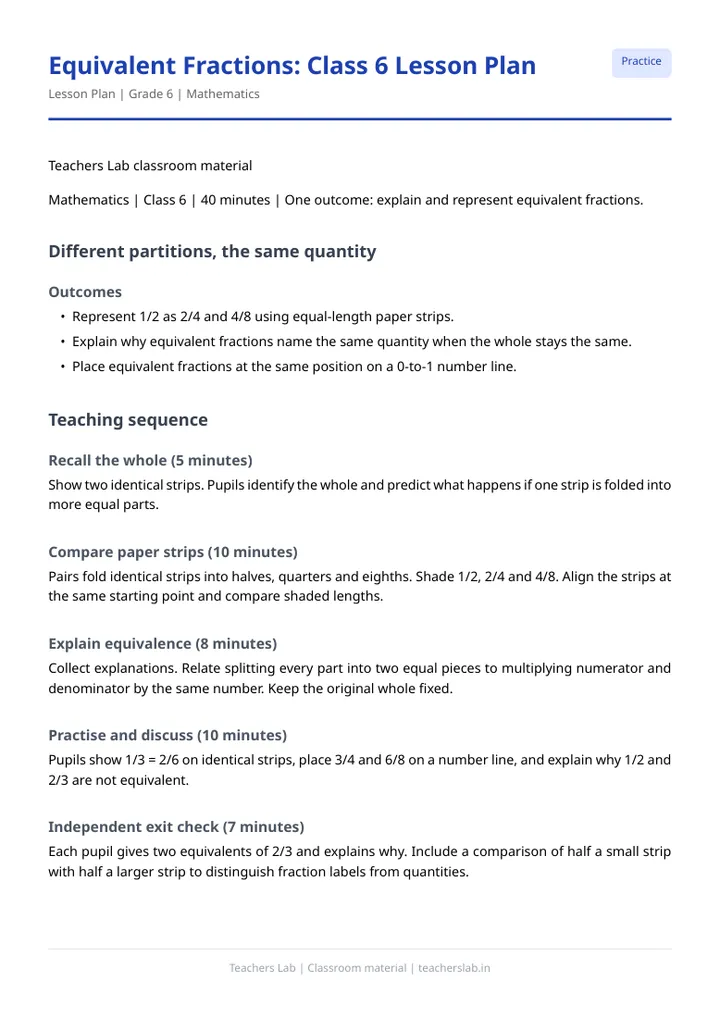
Different partitions, the same quantity
Outcomes
- Represent 1/2 as 2/4 and 4/8 using equal-length paper strips.
- Explain why equivalent fractions name the same quantity when the whole stays the same.
- Place equivalent fractions at the same position on a 0-to-1 number line.
| Stage | Minutes | Teacher and pupil activity |
|---|---|---|
| Recall the whole | 5 | Show two identical strips. Pupils identify the whole and predict what happens if one strip is folded into more equal parts. |
| Compare paper strips | 10 | Pairs fold identical strips into halves, quarters and eighths. Shade 1/2, 2/4 and 4/8. Align the strips at the same starting point and compare shaded lengths. |
| Explain equivalence | 8 | Collect explanations. Relate splitting every part into two equal pieces to multiplying numerator and denominator by the same number. Keep the original whole fixed. |
| Practise and discuss | 10 | Pupils show 1/3 = 2/6 on identical strips, place 3/4 and 6/8 on a number line, and explain why 1/2 and 2/3 are not equivalent. |
| Independent exit check | 7 | Each pupil gives two equivalents of 2/3 and explains why. Include a comparison of half a small strip with half a larger strip to distinguish fraction labels from quantities. |
What to check: Look for an explanation about equal wholes, equal positions or equal shaded lengths. A correct multiplication without an explanation may need a follow-up example.
Materials: equal-length paper strips, pencils, a ruler and a drawn number line.
Hindi teaching note: पूरा समान होना चाहिए। 1/2, 2/4 और 4/8 एक ही मात्रा दिखाते हैं। भाग छोटे होते जाते हैं, पर रंगा हुआ हिस्सा उतना ही रहता है।
Exit answers: 2/3 = 4/6 = 6/9. Multiplying numerator and denominator by the same non-zero whole number keeps the value unchanged. Half of differently sized wholes can represent different amounts.
Next lesson: compare unlike fractions using a common whole. Do not add fraction addition and subtraction to this introductory period simply to fill the plan.
Keep the whole the same
Give each pair identical paper strips. Fold one into halves and another into quarters. Shade one half on the first and two quarters on the second, then place the strips alongside each other. Pupils should describe what stayed equal and what changed.
The number of parts changed; the shaded amount did not. Ask pupils to complete “One half is equal to two quarters because…” before introducing a rule about multiplying numerator and denominator. If the explanation is only “we multiplied by two,” return to the strips and connect the symbolic step to the partitioning.
Now show two different-sized sheets, one half shaded on each. They represent the same fraction of their own wholes, but the shaded areas need not be equal. This is a useful distinction: an equal fraction value and an equal physical quantity are connected only when the wholes being compared are equal in size.
Make assessment part of the activity
During pair work, ask pupils to show three quarters as eighths. Look for six shaded eighths and an explanation that every original quarter was divided into two equal parts. A correct number reached by guessing gives us less evidence than a short explanation tied to the drawing.
Use the exit task 2/3 = ?/6 = ?/9. The answers are 4/6 and 6/9. If a pupil writes 3/6, ask whether adding the same number to numerator and denominator preserves the shaded proportion. Offer a drawing rather than immediately adding more symbolic exercises.
A pupil ready to extend the idea can find two fractions equivalent to 3/5 and justify them. A pupil needing support can work with halves and quarters using pre-folded strips. Both are still learning equivalence; the support changes the representation and starting demand.
Adapt the lesson plan for CBSE or ICSE
The mathematical idea can support CBSE and ICSE classrooms, but book order, terminology and prior practice may differ. Check your prescribed text and school plan before selecting the lesson. For a school that introduces equivalence earlier, use this as a diagnostic revision period rather than a first introduction.
For English and Hindi teaching, decide which terms pupils need to understand and use. A bilingual prompt can support explanation without replacing the mathematical relationship. Review translations of numerator, denominator and equal parts against the vocabulary used in your classroom.
The CBSE and ICSE lesson-plan guide discusses planning context more broadly. If you prefer a 5E structure, compare its stages with the filled Science 5E example; do not force five labels onto an activity that needs a different pace.
Collaborate with AI on the next period
Open the lesson plan generator, select relevant book pages or enter the topic, and state the period length and available materials.
Plan a 40-minute Class 6 Maths period on equivalent fractions. Use identical paper strips, connect the model to symbols, address different-sized wholes and include an exit task with answers. Assume pupils can identify halves and quarters. Keep addition of unlike fractions for another period.
Read the draft as if you were teaching it tomorrow. Can every pair obtain the materials? Are transitions realistic? Does the final question actually check the outcome? After the lesson, add the observed difficulty to your next brief. This is where teacher–AI collaboration becomes useful: your classroom evidence changes the next draft.
Common questions
Does this cover the full Fractions chapter?
No. It covers equivalence in one 40-minute period. Addition, subtraction and other fraction ideas need separate planning.
Can it be used in an ICSE classroom?
Yes as an adaptable mathematical activity, after checking the prescribed text, prior knowledge and school sequence. It is not an official ICSE plan.
Is a blank template included?
Yes. The PDF includes a reusable planning grid with space for outcomes, activities, checks and follow-up.
YOUR NEXT CLASS
Create a version for your classroom.
Bring your topic or book pages, then review and refine the resource for your students.
Start in Teachers Lab