
THE PREPARATION NOTEBOOK / Assessment
ICSE Class 10 English Language Competency-Based Questions: Examples and Answers
Practise inference, concise summary, grammar, notice and email writing with six original ICSE Class 10 English Language classroom tasks, suggested responses and teacher criteria.
Teachers Lab material · Free sample download
Written with AI assistance for Teachers Lab. The classroom examples are starting points for teachers to review and adapt.
Ask what the pupil must do with language
A pupil may identify a rule correctly and still struggle to use it in a letter or explain an inference from a passage. Competency-focused practice gives us a way to bring those uses of language into a classroom task.
CISCE’s ICSE Class X English Language practice bank includes writing, comprehension and grammar tasks. We can use the official resource to understand the kinds of thinking being practised, then create original material for the content and teaching time available.
Let’s work with a short Eco Club passage and a linked communication task. The packet below is a 20-mark classroom practice set, with a shorter passage and smaller tasks than a full board paper. When setting a full assessment, follow your school’s current syllabus, specimen-paper instructions and required formats.
Download the practice pack and teacher criteria
The student copy contains an original passage and six tasks. The teacher section supplies suggested responses where useful and separate classroom marking criteria. A model response is one possible answer; equivalent, well-supported interpretations and accurate language can also earn credit.
TEACHERS LAB CLASSROOM MATERIAL · 20 MARKS
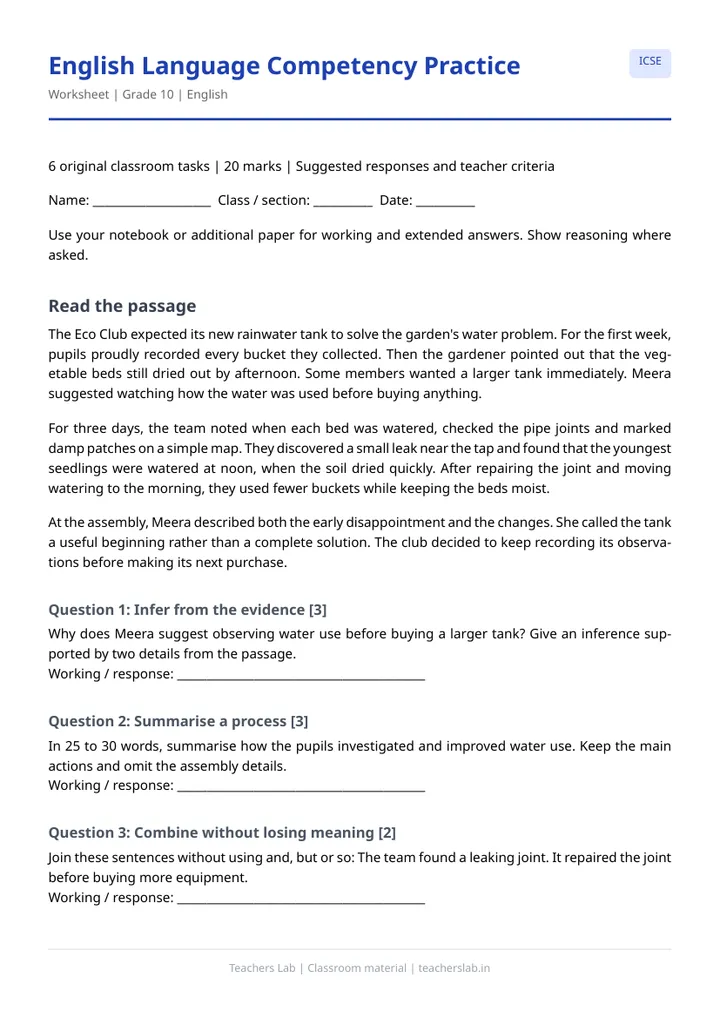
Read the passage
The Eco Club expected its new rainwater tank to solve the garden's water problem. For the first week, pupils proudly recorded every bucket they collected. Then the gardener pointed out that the vegetable beds still dried out by afternoon. Some members wanted a larger tank immediately. Meera suggested watching how the water was used before buying anything.
For three days, the team noted when each bed was watered, checked the pipe joints and marked damp patches on a simple map. They discovered a small leak near the tap and found that the youngest seedlings were watered at noon, when the soil dried quickly. After repairing the joint and moving watering to the morning, they used fewer buckets while keeping the beds moist.
At the assembly, Meera described both the early disappointment and the changes. She called the tank a useful beginning rather than a complete solution. The club decided to keep recording its observations before making its next purchase.
QUESTION 1 · 3 MARKS
Infer from the evidence
Why does Meera suggest observing water use before buying a larger tank? Give an inference supported by two details from the passage.
Suggested response and classroom marking criteria
- She suspects that the difficulty may involve how water is used, not only how much is collected.
- The team finds a leak near the tap.
- Changing the watering time and repairing the joint allow fewer buckets to keep the beds moist.
QUESTION 2 · 3 MARKS
Summarise a process
In 25 to 30 words, summarise how the pupils investigated and improved water use. Keep the main actions and omit the assembly details.
Suggested response and classroom marking criteria
- Include observation of watering, pipes or damp patches.
- Include repairing the leak and changing the watering time.
- Give a coherent summary within 25 to 30 words, without unrelated assembly details.
QUESTION 3 · 2 MARKS
Combine without losing meaning
Join these sentences without using and, but or so: The team found a leaking joint. It repaired the joint before buying more equipment.
Suggested response and classroom marking criteria
- Use a grammatical link, such as a participial clause or a relative clause.
- Retain the sequence and meaning of both original sentences.
QUESTION 4 · 2 MARKS
Report what was said
Change to reported speech: Meera said, "We will check the pipes tomorrow." Report her words on a later day as someone who is not a member of the team.
Suggested response and classroom marking criteria
- Change will to would and we to they, as the reporting context requires.
- Change tomorrow to the next day and retain the reporting clause.
QUESTION 5 · 5 MARKS
Write a purposeful notice
Your fictional school Eco Club is holding When Every Drop Counts, a water-conservation session for Classes IX and X, on 15 July from 10 a.m. to 11 a.m. in the school hall. Pupils must register with the Eco Club by 12 July and bring a notebook. Write a notice using these details.
Suggested response and classroom marking criteria
- Identify the school Eco Club and give a clear notice heading or event title.
- Give the event date, time and venue accurately.
- State the intended classes and purpose.
- Include registration by 12 July and the notebook instruction.
- Use concise, appropriate notice presentation and accurate language.
QUESTION 6 · 5 MARKS
Adapt the same context into an email
Write an email to a local water-conservation volunteer, inviting them to speak at the session described in Question 5. Use speaker@example.org as a fictional recipient. Explain the audience, arrangements and what you would like the speaker to cover.
Suggested response and classroom marking criteria
- Use a suitable recipient field, subject and salutation.
- Give the event purpose and audience.
- Include 15 July, 10 a.m. to 11 a.m. and the school hall.
- Make a clear, courteous invitation and request a useful speaking focus.
- Use coherent language and an appropriate closing.
Separate an inference from a copied sentence
The first question asks why Meera suggests observing water use before buying a larger tank. A response should infer that the problem may involve use and leakage rather than only storage capacity. The pupil then needs evidence: the leaking joint and the improvement after repairs and changed watering time.
Ask pupils to distinguish the claim from the supporting detail. If a response simply copies a sentence, invite the pupil to explain what that detail suggests. If the inference is reasonable but unsupported, ask which part of the passage helped them reach it.
AI can suggest alternative answers for you to consider. You still decide whether each one is supported by the actual passage. This is especially useful when a draft answer introduces an intention or fact that the text never establishes.
Give the summary a precise purpose
The short summary task asks for the investigation and improvements, leaving out the assembly details. Our example uses a 25–30-word classroom limit to practise selection and concision. It is a teaching choice for this packet, not a replacement for the instructions on a full examination paper.
Discuss what belongs before pupils start cutting words. Observing the watering, checking pipes, repairing the leak and changing the timing carry the process. Removing those ideas merely to make a response shorter would weaken the summary.
After pupils attempt the task, compare two possible responses and ask which preserves the process more clearly. AI can help draft that comparison, while the teacher checks the word count, faithfulness to the passage and usefulness of the discussion.
Make the notice and email share a purpose
The notice and email use the same fictional event. That allows pupils to concentrate on how audience changes the writing. The notice informs pupils about attendance and registration. The email invites a speaker and explains what contribution would be useful.
Keep the date, time, venue and purpose consistent across both. A fluent email that changes the event details has not followed the brief. A notice that contains every detail but hides the deadline in a long paragraph may need a clearer presentation.
The suggested responses show complete information and a suitable tone. Adapt their presentation to the format taught in your school. Use the five classroom criteria for feedback without presenting them as an official CISCE marking scheme.
Draft a version with Teachers Lab, then inspect it together
Choose Worksheet for a short practice set or Question Paper for a broader assessment. Use From a topic, select ICSE, Class 10, English and the relevant available curriculum unit. State explicitly that the focus is English Language. Add your original passage or relevant source context in the preparation brief where appropriate.
Create a short Class 10 ICSE English Language classroom practice set. Use the supplied original passage. Include an evidence-based inference, a short summary, two functional grammar tasks, and linked notice and email tasks. Provide possible responses and distinct teacher feedback criteria. Keep every event detail consistent and label the set as classroom practice.
If the draft becomes a general recall quiz, ask for tasks that use the language in context. If it produces a single rigid model answer for an open writing task, ask for acceptable alternatives and the qualities the teacher should look for.
Use feedback to choose one revision goal
Instead of rewriting every sentence for a pupil, select a goal: support an inference, preserve meaning during a transformation, or make a notice’s audience and deadline clear. A second attempt can then show whether the pupil has used the feedback.
Ask AI for another short context practising that same goal. Read it for unintended clues, ambiguous instructions and missing information before using it. Save the checked version and keep your own record of what needs another lesson.
Common questions
Is this a complete ICSE board paper?
It is a 20-mark classroom practice packet. Use the current syllabus and paper instructions when designing a full assessment.
Are the questions copied from CISCE?
The passage, tasks and suggested responses in this packet are original Teachers Lab classroom material. The article links to CISCE’s practice bank as a reference.
Must pupils reproduce the model answers exactly?
No. Judge whether a response meets the task, uses accurate language and supports interpretations with evidence. Use equivalent valid responses where appropriate.
YOUR NEXT CLASS
Create a version for your classroom.
Bring your topic or book pages, then review and refine the resource for your students.
Start in Teachers Lab